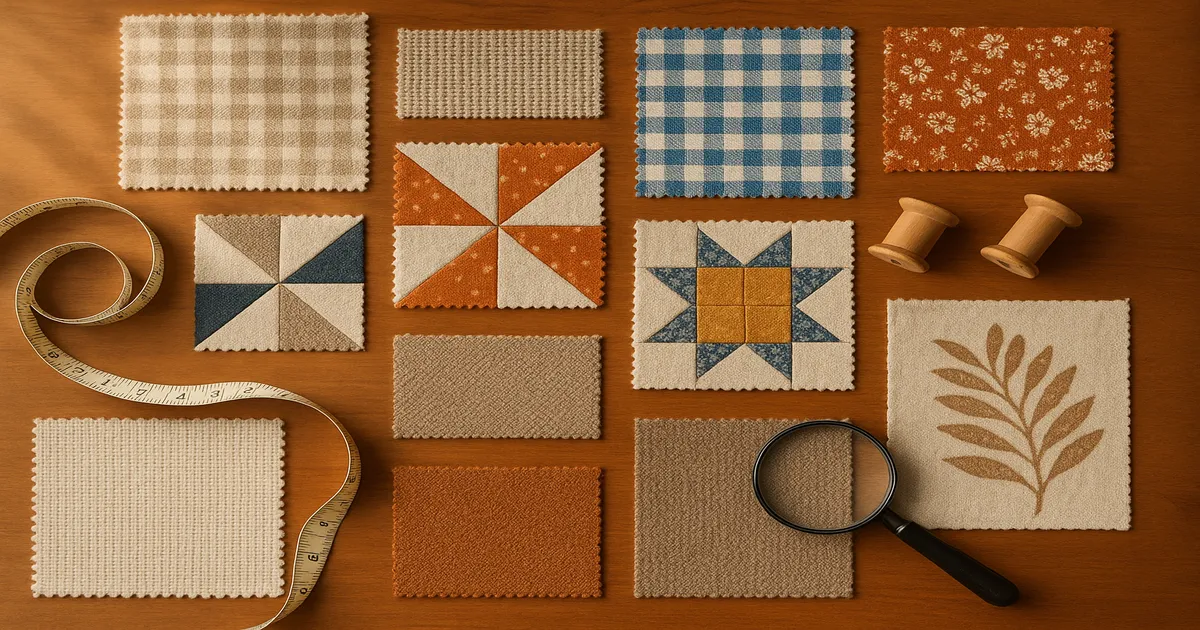
Quick Answer: “Pattern” means five different things in textiles — a fabric’s printed or woven surface design, its weave structure, a quilt block arrangement, a knit or crochet stitch sequence, or a paper/digital sewing template. Figure out which category you’re dealing with first, then narrow down from there.
If you’ve ever held up a piece of fabric and asked “what is this pattern?” — and then realized you weren’t even sure what kind of pattern you meant — welcome to the club. The word does a lot of heavy lifting in the textile world. A quilter asking that question means something completely different from a weaver or a dressmaker asking the same thing.
This guide walks through all five pattern types with a practical approach to identifying each one. No guessing, no squinting hopefully at Google Images.
What Is This Pattern? The Five Types of Textile Patterns
What Does “Pattern” Actually Mean in Sewing and Textiles?
Here’s the breakdown:
- Fabric surface patterns — printed or woven designs you can see: florals, stripes, paisleys, checks
- Weave/construction patterns — how threads interlace to form the fabric itself: twill, satin, plain weave
- Quilt block patterns — named geometric arrangements of pieced fabric: Log Cabin, Flying Geese, Ohio Star
- Knit/crochet stitch patterns — repeated stitch sequences creating texture or imagery: cables, lace, ribbing
- Sewing/garment patterns — the paper or digital templates you use to cut fabric pieces
Why Pattern Identification Gets Confusing
The same fabric can have a surface pattern and a distinctive weave structure at the same time. Houndstooth suiting, for example, is both a specific surface pattern and typically a twill weave. Add in regional quilt block naming variations and the fact that ikat is constantly mistaken for a bad print job, and it’s no wonder people get turned around. The fix is always the same: nail the category first, then get specific.
Step One: Figure Out Which Category You’re Looking At
Is the Design On the Fabric or In the Fabric?
Close your eyes and run your fingers across the surface. If you can feel the design as raised texture or a change in surface, you’re looking at a weave or knit structure. If the surface is smooth but carries color and imagery, it’s a surface pattern — either printed on or woven in as part of the design.
Holding paper or digital templates? That’s a sewing pattern, full stop. Pieced fabric blocks sewn together point toward a quilt pattern.
How to Assess the Pattern Repeat
Find where the design starts over — that’s your pattern repeat. Measure from one identical motif to the next in both directions: vertically (along the length) and horizontally (across the width). A metal seam gauge is more accurate than a fabric tape for this.
Repeats range from about ½ inch (13mm) for tiny ditsy prints to 36 inches (91cm) or more for large-scale decorator fabrics. If the motif shifts down by exactly half its height in alternating columns, you’ve got a half-drop repeat — common in quilting cotton and wallpaper.
Colorways vs. Pattern Structure
Many patterns exist in dozens of colorways. The structure — the arrangement of shapes and lines — stays constant while the colors change completely. Separate the two in your mind: identify the ground color (the background) and the figure colors (the motif) independently. This makes searching databases and describing the pattern to vendors much easier.
How to Identify Fabric Surface Patterns
Geometric Patterns: Stripes, Checks, Plaids, and Dots
Stripes are the most common geometric pattern, but there’s a whole vocabulary inside that category:
- Awning stripe — bold, equal-width alternating stripes, 1–3 inches (25–75mm) wide
- Pencil stripe — very fine, typically 1/16 inch (1.5mm) or less
- Candy stripe — equal-width stripes in bright colors on white
- Ticking stripe — narrow, utilitarian, traditionally navy or black on cream, about ⅛–¼ inch (3–6mm) wide; originally made for mattress covers
Checks and plaids have their own sub-hierarchy:
- Gingham — equal-sized checks in one color plus white; traditional gingham is woven, not printed; classic sizes are ⅛ inch (3mm), ¼ inch (6mm), and ½ inch (13mm)
- Tartan — a specific registered Scottish clan pattern; all tartans are plaids, but not all plaids are tartans
- Madras — lightweight, loosely woven plaid from Chennai, India; the bleeding, irregular color is intentional
- Houndstooth — interlocking four-pointed shapes in a 2×2 twill weave, classically black and white
- Glen plaid — small houndstooth overlaid with a larger windowpane check; you’ll see it constantly in suiting
- Buffalo check — large, bold two-color squares, typically 1–3 inches (25–75mm)
- Windowpane — thin lines forming large squares on a solid ground
For dots: a polka dot is uniform in size and evenly spaced. A pin dot is 1/16 inch (1.5mm) or less. A coin dot is ½ inch (13mm) or larger. Scattered irregular dots are just dot prints — not polka dots, no matter what the bolt end says.
Organic and Representational Patterns
- Ditsy floral — small, scattered flowers with no dominant direction; repeat usually under 2 inches (50mm)
- Chintz — large-scale, detailed floral, often with a glazed finish; historically Indian block-printed cotton
- Toile de Jouy — pastoral or figurative scenes printed in a single color on a light ground; originated in Jouy-en-Josas, France in the 1760s
- Jacobean floral — stylized tree-of-life motifs with large curved branches, rooted in 17th–18th century English crewelwork
Specialty Named Patterns: Paisley, Ikat, and Batik
Paisley is the curved teardrop motif that traveled from Persia through Kashmir shawls to the mills of Paisley, Scotland in the 18th and 19th centuries. You know it when you see it.
Ikat has blurry, feathered edges — and that’s not a flaw. The threads are resist-dyed before weaving, so the pattern bleeds slightly where dyed and undyed sections meet. The blurriness is the point. Check the back of the fabric: ikat shows on both sides because the pattern is in the threads themselves.
Batik is wax-resist dyed. Look for fine crackle lines where the wax fractured during the process — that’s the giveaway. Shibori is the Japanese cousin: resist-dyed in indigo, creating patterns like diagonal arashi lines or pleated kumo circles.
How to Identify Fabric Weave Structures
You Need a Loupe — There’s No Way Around It
You can’t reliably identify a weave structure by feel or appearance alone. A plain-weave cotton can be printed with a diagonal stripe that looks exactly like twill. Get a 10x jeweler’s loupe with a built-in LED and actually look at the threads. A fabric count magnifier with a calibrated 1-inch (25mm) window helps when you need to count threads per inch.
Plain Weave, Twill, Satin, and Basket Weave
- Plain weave (1/1): over one thread, under one thread, alternating. The simplest structure. Muslin, quilting cotton, chiffon.
- Twill (2/1, 2/2, 3/1): the over/under sequence offsets by one thread each row, creating diagonal lines on the surface. Denim is a classic 3×1 right-hand twill.
- Satin weave: long floats — threads that pass over many others before interlacing — create a lustrous, smooth surface. The longer the float, the shinier and the more delicate.
- Basket weave (2/2 plain): two threads treated as one in both directions, creating a subtle checkerboard texture with a slightly looser hand than plain weave.
Under the loupe, pick one thread and follow it: count how many threads it passes over before going under, then note when the sequence repeats. Over 1, under 1 — plain weave. Over 2, under 1 in a diagonal progression — twill.
How to Identify Quilt Block Patterns
Start With the Grid
Count the equal divisions across the block in one direction. Three divisions means a 9-patch grid. Two means a 4-patch. Four means a 16-patch. This single step eliminates most of the guesswork because it tells you which blocks are even possible.
Then identify the shapes inside: HSTs (half-square triangles, cut diagonally once), QSTs (quarter-square triangles, cut diagonally twice), hexagons, or curves. Curves — Drunkard’s Path, Double Wedding Ring — stand out immediately.
Named Quilt Blocks Quick-Reference
| Block Name | Grid | Key Shapes |
|---|---|---|
| Nine Patch | 3×3 | Squares only |
| Log Cabin | Radiating strips | Rectangles around center square |
| Flying Geese | 2×1 units | HSTs in directional triangles |
| Ohio Star | 3×3 | QSTs at corners, squares |
| Bear’s Paw | 4×4 | HSTs and squares |
| Dresden Plate | Circular | Wedge-shaped petals |
| Grandmother’s Flower Garden | Hexagonal | Hexagons in rosette arrangement |
| Pinwheel | 4-patch | HSTs suggesting rotation |
| Double Wedding Ring | Curved | Interlocking curved arcs |
What to Do When a Block Is Set On-Point
A Nine Patch rotated 45° looks nothing like a Nine Patch set straight. If a block isn’t resolving into a recognizable grid, rotate it — photograph it and rotate the image on your phone. This is one of the most common reasons people can’t identify a block they’d otherwise recognize immediately.
Regional naming variation is also real and significant. Bear’s Paw is also called Duck’s Foot in the Mud, Hand of Friendship, and Bear’s Foot depending on where and when it was made. Barbara Brackman’s Encyclopedia of Pieced Quilt Patterns is the authoritative reference, and BlockBase+ software from Electric Quilt puts over 4,000 named blocks in a searchable database. If you find one name, look for two more before you settle on it.
How to Identify Knit and Crochet Stitch Patterns
The texture tells you most of what you need to know:
- Flat and smooth → stockinette (knit) or single crochet
- Raised vertical ridges → ribbing (1×1, 2×2) or seed stitch
- Raised twisted ropes → cables
- Holes and eyelets → lace
- Raised bobbles or bumps → bobble, popcorn, or puff stitch
- Diagonal texture → twisted or slip-stitch patterns
To count a stitch repeat, count stitches across one complete unit of the pattern — from where it begins to where it begins again. Most stitch patterns repeat over 4, 6, 8, or 12 stitches, with a separate row repeat on top of that.
Ravelry’s pattern search lets you filter by stitch type, construction, and texture — genuinely useful for narrowing down an unknown stitch. Barbara Walker’s Treasury of Knitting Patterns series is the gold standard for knit stitch identification; if it’s a knit stitch, it’s almost certainly in there.
Tools for Accurate Pattern Identification
- 10x jeweler’s loupe with LED — non-negotiable for weave ID; $10–$30
- Fabric count magnifier — flat loupe with a calibrated 1-inch (25mm) window for counting threads per inch
- 6-inch metal seam gauge — for measuring repeats accurately
- Smartphone macro lens attachment — for photographing details to share online
- 5000–6500K daylight bulb — color accuracy matters when you’re distinguishing navy from black or identifying subtle colorways
The Burn Test for Fiber Content
When fiber content affects your identification — and it often does — the burn test is your friend. Hold a small thread snippet with tweezers over a metal dish and touch a lighter to it:
- Cotton — burns cleanly, smells like paper, leaves soft gray ash
- Polyester — melts and beads, smells chemical, leaves a hard plastic bead
- Wool — burns slowly, smells like burning hair, self-extinguishes
- Silk — chars rather than melts, smells similar to wool, leaves crushable ash
Digital Tools
Google Lens is genuinely good at surface pattern identification — photograph the fabric and let it reverse-image-search. For community help, Reddit’s r/whatisthisfabric, r/quilting, r/knitting, and r/sewing all have active members who identify unknown patterns regularly. BlockBase+ handles quilt blocks. Ravelry handles knit and crochet.
Common Pattern Identification Mistakes
Calling every plaid a tartan. A plaid is any crossed-stripe pattern. Tartan refers specifically to a registered Scottish clan or institutional pattern. The distinction matters when you’re sourcing reproduction fabric for historical projects.
Assuming every dotted fabric is a polka dot. True polka dots are uniform in size and evenly distributed. Scattered irregular dots, oversized spots, and confetti-style prints are different things — and the distinction matters when you’re matching fabric or describing it to a vendor.
Mistaking ikat for a bad print. Someone finds a beautiful fabric with soft, feathered edges and assumes it’s a printing flaw. It’s not — it’s ikat, and the blurriness is intentional. Check the back: ikat shows on both sides. A printed pattern lives only on the face.
Giving up on a quilt block before rotating it. Always try rotating your image 45° before concluding you have an unknown block.
Frequently Asked Questions About Pattern Identification
What is this pattern on my fabric — how do I even start identifying it?
Start by asking whether the design is on the fabric (a surface print) or in the fabric (a weave structure). Run your fingers across it — if you can feel the design, it’s structural. If the surface is smooth, it’s printed or woven-in color. From there, match what you see to the named categories above: geometric, organic, specialty print, or weave structure.
What is the difference between a plaid and a tartan?
A plaid is any fabric pattern made of crossed horizontal and vertical stripes forming a grid. A tartan is a specific, officially registered plaid pattern associated with a Scottish clan or institution. Every tartan is a plaid, but the vast majority of plaids in fabric stores are not tartans.
How do I identify a quilt block pattern I don’t recognize?
Count the grid divisions across the block — this tells you whether you’re looking at a 4-patch, 9-patch, or 16-patch structure. Then identify the shapes inside: squares, half-square triangles, quarter-square triangles, or curves. If the block is set on-point, rotate the image 45°. BlockBase+ software from Electric Quilt has over 4,000 named blocks and is the most thorough digital reference available.
What is the difference between ikat and batik?
Ikat is a woven fabric where threads are resist-dyed before weaving, creating blurry, feathered-edge patterns that show on both sides of the fabric. Batik is surface-dyed: wax is applied to resist dye penetration, leaving crackle lines where the wax fractured. Both are resist-dye techniques, but the process and result are quite different.
How can I tell what weave structure a fabric has?
Use a 10x jeweler’s loupe — ideally one with a built-in LED. Pick one thread and follow it under magnification: count how many threads it passes over before going under, then note when the sequence repeats. Over 1, under 1 is plain weave. A diagonal progression of over 2, under 1 is twill. Long floats with minimal interlacing points to satin weave.