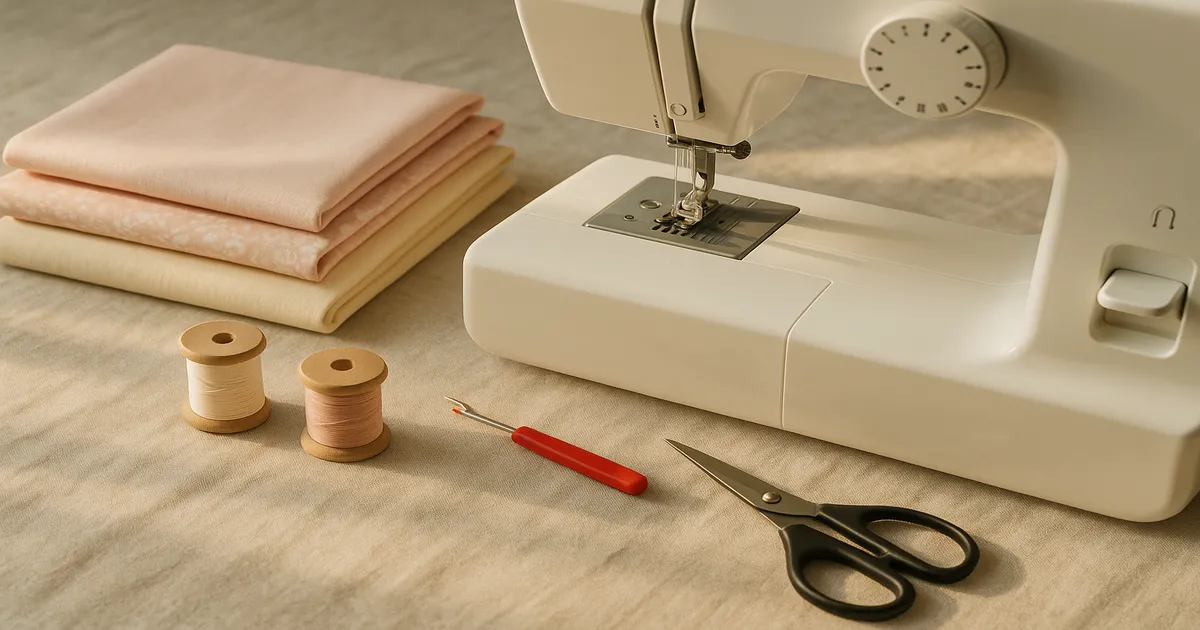
Quick Answer: The best sewing machine for beginners right now is the Brother CS6000i — it hits the $150–$180 sweet spot with a top-loading bobbin, speed control slider, and enough features to grow with you without becoming overwhelming. Tighter budget? The Brother XM2701 gets the job done. Want something built to last a decade? Look at Janome or Bernette.
Picking your first sewing machine seems straightforward until you’re staring at forty options online, all making the same vague promises about “professional results” and “easy setup.” So what’s the best sewing machine for beginners that you’d actually recommend buying today — not just the one with the best Amazon listing? That’s what this guide is for. Short list, honest opinions, no fluff.
The Best Beginner Sewing Machines Right Now
Best Overall: Brother CS6000i
Price: $150–$180 | Stitches: 60 | Bobbin: Top-loading drop-in | Throat: 4.7 in (12 cm) | SPM: 850 | Weight: 13 lbs (5.9 kg)
The Brother CS6000i is the machine I’d hand to almost any beginner without hesitation. It’s computerized but not intimidating — the LCD display is clear, the stitches are organized logically, and the speed control slider means you can cap how fast the needle moves independently of how hard you press the foot pedal. That last feature matters more than people realize when you’re still learning to steer fabric.
Seven presser feet come in the box, the buttonhole is fully automatic (one step, not four), and the drop-in bobbin is visible through a clear cover so you can actually see what’s happening. At this price, the value is hard to argue with.
Best for Heavy Fabrics: Singer Heavy Duty 4452
Price: $200–$230 | Stitches: 32 | Bobbin: Top-loading | SPM: 1,100 | Weight: 14.5 lbs (6.6 kg)
The Singer Heavy Duty 4452 is built around a metal frame and a powerful motor that’ll push through eight layers of denim without complaint. At 1,100 stitches per minute, it’s the fastest machine in this price class. If you’re planning to sew bags, home décor, or heavier garments from the start, this is your machine.
The trade-off: it uses a 4-step buttonhole instead of a 1-step automatic. More tedious, but totally learnable.
Best Budget Pick: Brother XM2701
Price: $80–$100 | Stitches: 27 | Bobbin: Top-loading drop-in | SPM: ~400
The Brother XM2701 is fine if you genuinely aren’t sure sewing will stick and don’t want to commit more money yet. Drop-in bobbin, six presser feet, decent stitch selection for the price. Just be realistic: the plastic internals have limits. It’s a starter machine, not a forever machine.
Best Long-Term Investment: Janome 2212 or 3120QDC
The Janome 2212 is a mechanical machine with a reputation for bulletproof reliability — twelve stitches, solid tension system, nothing fancy, and it’ll still be running cleanly in fifteen years. The Janome 3120QDC steps up to computerized controls with one of the best tension systems in this price range ($280–$320). Both are worth the extra spend if you’re serious about the hobby from day one.
Best Step-Up Build Quality: Bernette b35
Price: $280–$350 | Stitches: 23 | Bobbin: Top-loading
The Bernette b35 is the entry point into Bernina’s ecosystem, and the build quality shows it. Precise stitching, excellent tension system, built to handle years of regular use. If you’re the kind of person who buys tools once and keeps them forever, this is worth stretching the budget for.
| Machine | Type | Price | Stitches | SPM | Best For |
|---|---|---|---|---|---|
| Brother CS6000i | Computerized | $150–$180 | 60 | 850 | Best overall |
| Singer HD 4452 | Mechanical | $200–$230 | 32 | 1,100 | Heavy fabrics |
| Brother XM2701 | Computerized | $80–$100 | 27 | ~400 | Tightest budgets |
| Janome 2212 | Mechanical | $180–$220 | 12 | ~820 | Long-term reliability |
| Janome 3120QDC | Computerized | $280–$320 | 30 | ~820 | Best tension system |
| Bernette b35 | Computerized | $280–$350 | 23 | ~900 | Step-up build quality |
What to Look for When Buying Your First Sewing Machine
Bobbin System: This One Feature Matters Most
Top-loading drop-in bobbins sit horizontally under a clear cover on the machine’s bed. You can see the thread, troubleshoot easily, and reload in seconds. Front-loading bobbins sit in a removable case that you thread separately — fiddly, and much easier to get wrong. For beginners, top-loading wins every time.
Mechanical vs. Computerized
Mechanical machines use physical dials to select stitches. Computerized machines use a microprocessor — press a button, the machine sets the parameters. Both work fine for beginners. Computerized machines make buttonholes dramatically easier (1-step vs. 4-step) and often give clearer tension feedback. Mechanical machines are simpler to troubleshoot and easier to repair long-term. I lean toward computerized for most beginners, but it’s not a dealbreaker either way.
One spec worth knowing: look for a rotary hook rather than an oscillating hook. Rotary hook machines produce smoother, quieter stitches and skip less. Most machines in the $150+ range use them.
Stitch Count, Throat Space, and Speed
You need 8–12 stitches to cover 95% of what beginners sew. Anything beyond 30–40 is marketing noise at this stage. Don’t let a high stitch count be the deciding factor.
Throat space — the gap between the needle and the right side of the machine body — should be at least 4 inches (10 cm) for garment sewing. For quilting, aim for 6 inches (15 cm) or more. The CS6000i’s 4.7-inch (12 cm) throat is solid for garments and light quilting.
A speed control slider (separate from foot pedal pressure) lets you cap the machine’s maximum speed. It’s genuinely useful when you’re still learning to steer fabric, and it’s one of the features that separates a real beginner machine from a toy.
Why Cheap Machines Kill the Hobby
Machines under $80 almost universally use plastic internal gears and simplified feed dog systems. They work fine for ten minutes on a demo video. In real use, they produce inconsistent tension, strip gears on anything thicker than quilting cotton, and end up in closets. Spending an extra $70–$100 upfront saves the hobby — and that’s not an exaggeration. Most people who “tried sewing and hated it” were fighting a bad machine, not a learning curve.
How to Choose the Best Beginner Sewing Machine for Your Situation
What will you sew? Garments need reliable tension and a good zigzag. Quilting demands more throat space. Home décor — curtains, cushions, slipcovers — often involves heavier fabrics, so motor power matters more.
How often will you sew? Once a month for gifts? A mechanical machine or the XM2701 will serve you fine. Planning to sew weekly or develop a real skill? Invest in a mid-range machine from the start. You’ll outgrow a budget machine faster than you expect.
New or used? A used Janome or Bernina can be a fantastic deal — older machines from quality brands are often more durable than new budget machines. Always test in person: sew on multiple layers, listen for grinding or rattling, check that tension looks clean on both sides of the fabric, and watch for skipped stitches on a straight seam (a red flag for timing issues).
Budget reality check: Under $100 gets you a machine that might frustrate you into quitting. Over $400 gets you features you won’t understand for years. The $150–$250 range is where real machines live.
Setting Up Your Machine: The Steps People Get Wrong
Wind the bobbin correctly. Follow your machine’s specific winding path exactly — it varies by model. Thread should wind evenly and firmly. A loose or lopsided bobbin causes bottom-thread tension problems that look maddening to diagnose.
Thread the upper thread in sequence. Follow the numbered guides in order. The most commonly missed step is the take-up lever — the moving hook near the top of the machine. Skip it and you’ll get thread jams within the first few stitches. Always thread with the presser foot raised; with the foot down, the tension discs are closed and the thread won’t seat properly.
Test on scrap fabric first. Always. Sew on the same fabric and same number of layers you’ll be using for your project. Loops on the top of the fabric mean bobbin tension is too tight (or upper tension too loose); loops on the bottom mean the opposite. Adjust in small increments. This step is non-negotiable.
For standard sewing, set stitch length to 2.5 mm for most woven fabrics. Tension defaults around 4–4.5 on a 0–9 scale are a good starting point.
What to Buy Alongside Your Machine
Thread: Use 40-weight all-purpose polyester from a reliable brand. Gutermann and Coats & Clark are both solid. Cheap no-name thread sheds lint, breaks constantly, and causes tension headaches. False economy.
Needles: Start with a Universal 80/12 — correct for most medium-weight woven fabrics. Schmetz are the industry standard; generic needles aren’t worth the savings. Change your needle every 6–8 hours of sewing time, or at the start of every new project. A dull needle causes more problems than almost anything else.
Basic needle kit:
- Universal 70/10 — lightweight fabrics
- Universal 80/12 — medium-weight wovens (your default)
- Universal 90/14 — heavier home décor fabrics
- Denim 90/14 or 100/16 — for when you’re ready to tackle jeans
Practice fabric: Start with 100% quilting cotton or unbleached muslin. Both are stable, press well, and forgive beginner handling. Buy at least 1 yard (91 cm) before cutting into anything you care about. Avoid knits, silk, chiffon, and denim for your first few projects.
The non-negotiables:
- Seam ripper — get a Clover and keep it within arm’s reach
- 8-inch (20 cm) dressmaker’s shears — Gingher or Kai; never use them on paper
- Steam iron and ironing board — pressing seams is as important as sewing them
- Seam gauge — a 6-inch (15 cm) ruler with a sliding marker
- Glass-head straight pins — plastic heads melt under an iron
- Wonder Clips — for thick fabrics that pins distort
FAQ: Best Sewing Machine for Beginners
Is the Brother CS6000i really the best sewing machine for beginners? For most people, yes. It’s computerized without being complicated, has a top-loading bobbin, a speed control slider, and a 1-step buttonhole — all the features that make learning easier — at a price that doesn’t require a commitment you’ll regret. If you’re planning to sew heavy fabrics from day one, the Singer HD 4452 is a better fit.
How much should a beginner spend on a sewing machine? The honest answer is $150–$250. Below $100, you’re likely buying frustration. Above $400, you’re paying for features you won’t use for years. The mid-range is where machines are actually built to perform.
Can I learn to sew on a mechanical machine instead of a computerized one? Absolutely. Mechanical machines are simpler to troubleshoot and often more repairable. The main thing you give up is the 1-step automatic buttonhole, which is a real convenience for garment sewing. The Janome 2212 is an excellent mechanical option if you prefer dials over buttons.
What’s the difference between a 1-step and 4-step buttonhole? A 4-step buttonhole requires you to manually sew each segment in sequence, flipping a lever between steps. A 1-step automatic senses the button size and sews the whole thing in one pass. If you plan to make garments with buttons, the 1-step version is worth prioritizing.
Should I buy a used sewing machine? A used Janome or Bernina from a quality era can be a better machine than a new budget model. The key is testing in person: sew on multiple layers, listen for grinding, and check for skipped stitches on a straight seam. If the timing is off, repair costs can exceed the machine’s value — so walk away from anything that skips.