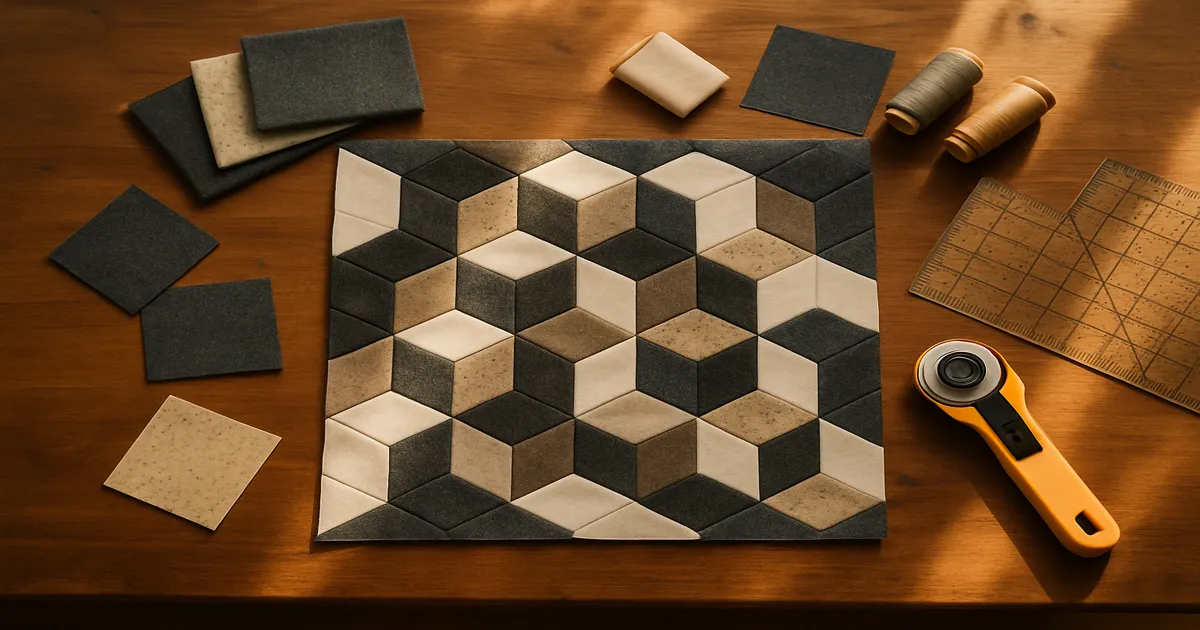
Quick Answer: The single most effective way to give the illusion of blocks in quilting is strategic light/medium/dark value placement using 60-degree diamonds — the classic Tumbling Blocks method. If Y-seams aren’t your thing yet, a value-gradient square grid delivers nearly the same optical punch using nothing but straight seams and basic squares.
The best way to give the illusion of blocks comes down to one thing more than anything else: value contrast. Not colour. Not pattern. Value — how light or dark a fabric reads when you strip away the hue. Every method covered here works on that same principle, whether you’re sewing 60-degree diamonds with Y-seams or arranging a simple grid of squares in a gradient from cream to charcoal. Get the values right and the illusion practically builds itself. Get them wrong, and even technically perfect piecing will look flat.
Quick Answer: The Best Way to Give the Illusion of Blocks
Top Pick: The Classic Tumbling Blocks Method
Tumbling Blocks is the gold standard — three 60-degree diamonds in light, medium, and dark values, arranged to simulate an isometric cube. American quilters have been using this exact trick since the 1840s, and it still produces the strongest 3D illusion of any flat-pieced method. The catch is Y-seams, which take practice but aren’t nearly as scary as their reputation suggests.
Runner-Up: Value-Gradient Square Grid
Not ready for Y-seams? A gradient grid of squares — five to nine fabrics in a single colour family, arranged dark to light — reads to the eye as a curved or receding surface. No diamonds, no Y-seams, no templates. It’s the most beginner-friendly entry point into optical illusion design, and it’s genuinely beautiful in its own right.
What Makes the Illusion of Blocks Work: Key Design Criteria
Value Contrast: The Non-Negotiable Foundation
Value contrast is the engine behind every block illusion, full stop. If your three fabrics all read as medium-grey in a black-and-white photo, no amount of clever piecing will save you. Your light, medium, and dark fabrics should be at least two to three steps apart on a ten-point value scale — the further apart, the stronger the illusion.
Two tests I always recommend: the squint test (blur your eyes until individual prints disappear — does the 3D effect still read?) and the greyscale phone photo (snap a picture and desaturate it in any photo app). Do both before you cut a single piece.
Colour Temperature: Warm Lights, Cool Darks
This is the detail that separates a good illusion from a great one. Real-world light is warm — sunlight, incandescent bulbs. Real-world shadows are cool — blue, purple, grey. If your light fabric is warm-toned (cream, butter yellow, peach) and your dark is cool-toned (navy, charcoal, dusty purple), the brain reads “three-dimensional object” almost automatically. It’s a small tweak with a disproportionate payoff.
Fabric Choice: Solids vs. Prints
Solids and shot cottons win here, consistently. Busy prints create visual noise that fights the geometric illusion — the eye gets confused about what it’s supposed to be reading. Kona Cotton Solids and Bella Solids are the industry workhorses for a reason. If you want to use prints, audition them at arm’s length — if you can read the pattern clearly from 18 inches (46 cm) away, it’s too busy.
Geometric Precision: Why Accuracy Is Everything
Misalignment of even 1/16 inch (1.5 mm) is visible in a Tumbling Blocks quilt. That’s not hyperbole. Diamond points that don’t meet precisely destroy the illusion at exactly the spot where the eye is looking for it. A consistent ¼-inch (6 mm) seam allowance, every single seam, is non-negotiable.
Quilting Density: Less Is More
Heavy quilting lines that cross block boundaries create a secondary pattern that competes with the illusion. Quilt in the ditch, or use a very subtle all-over texture at 1-inch (2.5 cm) intervals or wider. This is the mistake I see most often in otherwise excellent illusion quilts — someone spends months getting the piecing perfect, then quilts a dense feather design straight across the cube faces.
At-a-Glance Comparison: Block Illusion Methods
| Method | Skill Level | Seam Type | Shapes Used | Fabrics Needed | Y-Seams | Best For | Illusion Strength |
|---|---|---|---|---|---|---|---|
| Tumbling Blocks | Intermediate–Advanced | Set-in/Y-seam | 60° Diamonds | 3 (light/med/dark) | Yes | Maximum 3D impact | ★★★★★ |
| Value-Gradient Grid | Beginner | Straight | Squares | 5–9 | No | Beginners, modern look | ★★★☆☆ |
| HST Optical Illusions | Intermediate | Straight | Half-square triangles | 2–4 | No | HST-familiar quilters | ★★★★☆ |
| Bargello | Beginner–Intermediate | Straight | Strips/Rectangles | 8–16 | No | Speed + drama | ★★★★☆ |
| Cathedral Windows | Advanced (hand) | Hand-folded | Folded squares | 2+ | No | Heirloom hand-sewing | ★★★☆☆ |
Tumbling Blocks (Classic 60-Degree Diamond Method)
Nothing else comes close for sheer three-dimensional impact. Three diamonds — light, medium, dark — arranged at 60 degrees to simulate an isometric cube. It’s been working since the 1840s and it’ll keep working.
Key specs:
- Shape: 60-degree diamond
- Value groups required: 3 (light, medium, dark)
- Typical finished diamond size: 2–3 inches (5–7.6 cm)
- Y-seams: Yes
- Seam allowance: ¼ inch (6 mm), stopping ¼ inch (6 mm) from each corner
Pros
- Strongest 3D illusion of any flat-pieced method
- Historically rich — excellent for heirloom quilts
- Great stash-buster; works with almost any fabric as long as values are right
- Teaches precision skills that transfer to every other technique
Cons
- Y-seams intimidate beginners and require practice
- Bias edges stretch if not starched and handled carefully
- Slowest of all the methods to assemble
Step-by-Step: Cutting Your 60-Degree Diamonds
- Press and starch all fabrics before cutting — stiff fabric behaves on the bias.
- Cut strips equal to your desired finished diamond size plus ½ inch (12 mm) for seam allowances. For a 2-inch (5 cm) finished diamond, cut strips 2½ inches (6.4 cm) wide.
- Using a 60-degree ruler or the 60-degree line on your standard quilting ruler, sub-cut the strips into diamonds every 2½ inches (6.4 cm) along the strip.
- Cut equal quantities of each value group — one light, one medium, one dark per cube unit.
Step-by-Step: Mastering the Y-Seam
- Mark the ¼-inch (6 mm) seam intersection on the wrong side of every diamond — a Hera marker works perfectly here, leaving a crease but no ink.
- Place the light and medium diamonds right sides together. Sew from the marked corner point to the opposite marked corner point. Backstitch at both ends. Do not sew into the seam allowance.
- Open the unit and add the dark diamond, again sewing only between the marked points.
- Press seams open at the Y-seam junction — this distributes bulk evenly and keeps the surface flat.
- Check that all three diamond points meet precisely at the centre of the cube face.
Verdict
Best for: Quilters comfortable with set-in seams who want maximum visual impact. This is the method that makes people stop and stare.
Value-Gradient Square Grid (Modern Straight-Seam Method)
A contemporary approach that proves you don’t need Y-seams to give the illusion of blocks. Five to nine fabrics in a single colour family, arranged in a gradient from dark to light across a simple square grid, read as a curved or receding surface. The illusion is subtler than Tumbling Blocks, but it’s genuinely effective — and the assembly is a fraction of the stress.
Key specs:
- Shape: Uniform squares
- Recommended cut size: 2½ inches (6.4 cm) — 2-inch (5 cm) finished
- Fabrics needed: 5–9 in a single colour family
- Y-seams: None
- Design wall: Essential
Pros
- Completely beginner-friendly — straight seams only
- Fast to assemble once the gradient is planned
- Works with any colour palette; great for using up a colour-family stash
- Highly adaptable — works in squares, rectangles, or even hexagons
Cons
- Illusion is noticeably subtler than Tumbling Blocks
- Requires careful gradient planning on a design wall before a single seam is sewn
- Fewer than five fabrics produces a weak, unconvincing effect
Step-by-Step: Planning and Arranging Your Gradient
- Plan your gradient on graph paper or in EQ8 software (Electric Quilt EQ8) before touching your fabric. Map the darkest value to one corner and the lightest to the opposite corner, with intermediate values filling the diagonal.
- Cut all squares and arrange every single one on your design wall before sewing. Don’t skip this step — it looks tedious and it absolutely matters.
- Take a greyscale phone photo of the arrangement and check that the gradient reads clearly.
- Sew in rows, pressing seam allowances in alternating directions so rows nest together cleanly.
- Step back 6–10 feet (1.8–3 m) and squint. The surface should appear to curve or recede.
Verdict
Best for: Beginners or quilters who want a modern, low-stress introduction to optical illusion design without learning any new techniques.
Half-Square Triangle (HST) Optical Illusions
HSTs are probably the most familiar unit in all of quilting, and they’re capable of producing some seriously disorienting optical effects. The key is arrangement — the same HST unit can spin, recede, or stack depending on how you rotate and combine it.
Key specs:
- Formula: Finished size + ⅞ inch (22 mm) for cut squares
- Example: 3-inch (7.6 cm) finished HST = 3⅞-inch (9.8 cm) cut squares
- Press toward dark fabric; consistent direction is mandatory
- Y-seams: None
Pros
- Most quilters already know how to make HSTs — no new skills required
- Huge variety of illusion patterns available
- Scales easily from small throws to king-size quilts
- No Y-seams, no templates
Cons
- Illusion depends entirely on consistent pressing — one puckered seam physically distorts the flat surface and breaks the effect
- Colour placement planning is more complex than it looks; mistakes are only obvious after many blocks are assembled
Key Patterns: Storm at Sea and Tumbling Pinwheels
Storm at Sea combines HSTs with squares and rectangles to produce a genuinely vertiginous receding-grid effect — one of the most impressive illusion quilts you can make with straight seams. Tumbling Pinwheels uses value contrast within the HST units themselves to simulate the stacked-cube effect of Tumbling Blocks, but with far more forgiving piecing. Either one is a solid next step after you’ve mastered basic HST construction.
Verdict
Best for: Intermediate quilters who already know HSTs and want to explore optical design without picking up a single new technique.
Bargello Quilts (Wave and Undulation Illusion)
Bargello looks impossibly complex and is actually built from nothing but straight seams. Strips are sewn into tubes, cross-cut into segments, and rearranged to shift the colour gradient up or down — creating the illusion of undulating waves or depth. Named after the Bargello needlepoint stitch, the quilting version has been popular since the 1990s and hasn’t lost any of its visual punch.
Key specs:
- Shapes: Strips and rectangles only
- Fabrics needed: 8–16 values in a single colour family
- Y-seams: None
- Templates: None required
Pros
- No Y-seams, no diamonds, no templates — genuinely the simplest construction method here
- Very fast once the strip sets are sewn
- Dramatic visual impact that beginners can achieve on a first attempt
- Excellent for using up a large collection in one colour family
Cons
- Planning the strip sequence is confusing at first — a planning error discovered after cross-cutting is very hard to fix
- Precise strip widths are non-negotiable; even small variations throw off the gradient shift
- Less flexible than other methods for colour palette changes mid-project
How the Bargello Illusion Is Constructed
Sew all your value-ordered strips together lengthwise into a strip set, then join the long edges to form a tube. Cross-cut the tube into segments of varying widths. Offset each segment by one strip position up or down when you join them, and the gradient appears to wave across the surface. The width variation of the cross-cut segments controls whether the wave is gentle or dramatic.
Verdict
Best for: Beginners who want a dramatic illusion result with the simplest possible piecing. This is the highest wow-to-difficulty ratio of any method on this list.
Cathedral Windows (Receding Grid Illusion)
Cathedral Windows is genuinely unique among illusion methods because the depth effect comes partly from actual physical dimension — the folded fabric creates real texture — rather than colour placement alone. It’s also the only method here that traditionally requires no batting and no machine sewing.
Key specs:
- Construction: Hand-folded fabric squares
- Finished window size: Typically 1½–2 inches (3.8–5 cm)
- Batting: Not required
- Machine-friendly: Not in traditional form; modern adaptations exist
Pros
- No batting needed — lighter and more portable than a standard quilt
- The folding creates genuine dimensional texture that enhances the illusion beyond what colour alone can do
- Portable hand-sewing project — ideal for travel or slow evenings
- Heirloom quality; these quilts last for generations
Cons
- Extremely time-intensive — a lap-size Cathedral Windows quilt is a multi-year project for most people
- Not suitable for machine sewing in the traditional method; modern adaptations sacrifice some of the effect
- Limited colour flexibility compared to pieced methods
Construction Overview
Each “window” starts as a large fabric square — typically 6 inches (15.2 cm) cut, folding down to a 2¾-inch (7 cm) padded square after pressing and stitching — folded in quarters and stitched to form a smaller padded unit. Four folded squares are joined together, and a small contrast fabric square is placed at the junction. The edges of the folded squares are then rolled back and slip-stitched over the contrast square, creating the characteristic rounded “window” frame. Repeat several hundred times. It’s meditative, or maddening, depending on your temperament.
Verdict
Best for: Hand-sewers who want a tactile, heirloom illusion project and genuinely enjoy a slow process. This is not a technique for anyone with a deadline.
Our Verdict: Best Block Illusion Method by Use Case
Best Overall: Tumbling Blocks
Nothing produces a stronger 3D illusion of blocks. If you’re willing to learn Y-seams — and I promise they’re learnable — this is the method that earns the gasps.
Best for Beginners: Value-Gradient Square Grid
Straight seams, no templates, same optical principle. Start here, get comfortable reading values, then graduate to Tumbling Blocks.
Best for Speed: Bargello
Once your strip sets are sewn, a Bargello quilt comes together remarkably fast. The planning phase honestly takes longer than the sewing.
Best for HST Lovers: Storm at Sea / Tumbling Pinwheels
If your scrap bin is full of HSTs and you want to try optical design without learning anything new, Storm at Sea is the move.
Best Heirloom Project: Cathedral Windows
Slow, beautiful, genuinely dimensional. Give yourself a year and enjoy every stitch.
Best Stash-Buster: Tumbling Blocks or Bargello
Both methods depend on value relationships rather than specific prints, which means they eat through a stash beautifully. Bargello is faster; Tumbling Blocks is more dramatic.
Regardless of which method you choose, do the greyscale test before you commit to any fabric selection. It takes thirty seconds and it will save you hours of frustration.
Common Mistakes That Break the Block Illusion
Choosing Fabrics by Colour Instead of Value
This is by far the most common reason an illusion quilt falls flat — literally. Three fabrics that are different colours but identical values produce a muddy, shapeless result. Fix: Photograph your fabric selection and convert to greyscale before cutting anything. Your light, medium, and dark should be clearly distinct even in black and white.
Sewing Through the Seam Allowance on Y-Seams
If you stitch all the way to the cut edge on a Y-seam, the fabric will pucker and the cube point will distort. Fix: Mark the ¼-inch (6 mm) seam intersection on the wrong side of every diamond with a Hera marker before you start sewing. Stop exactly at that mark, backstitch, and reposition.
Inconsistent Seam Allowances
Varying between ¼ inch (6 mm) and ⅜ inch (9.5 mm) — even slightly — means diamond points won’t meet and rows won’t align. Fix: Test your setup before starting. Sew two 2½-inch (6.4 cm) squares together, press, and measure. The result should be exactly 4½ inches (11.4 cm). Adjust your needle position or presser foot if it’s not.
Pressing Toward the Bulk
At Y-seam intersections, pressing to one side creates a lump that prevents the quilt from lying flat — and a lumpy surface physically undermines the visual illusion. Fix: Press seams open at every Y-seam junction. It takes a little longer, but the result is dramatically flatter.
Skipping the Design Wall
Arranging fabric on a table and sewing immediately is how you end up with 30 blocks assembled in the wrong order. Fix: Pin everything to your design wall first and step back 6–10 feet (1.8–3 m). The illusion should be visible from across the room before you sew a single seam.
Over-Quilting Across Block Boundaries
Dense quilting lines that cross the cube faces create a secondary pattern that fights the block illusion. Fix: Quilt in the ditch along seam lines, or use a subtle all-over texture at 1-inch (2.5 cm) intervals or wider. The quilting should support the design, not compete with it.
Expert Tips for a Stronger Block Illusion
Starch everything before cutting. Spray starch applied before cutting reduces bias stretch significantly. (Mary Ellen’s Best Press) Stiff fabric behaves during cutting, stays put while you’re positioning it for Y-seams, and produces more accurate pieces overall.
Chain-piece your diamonds. Instead of completing one cube at a time, sew all your light-to-medium pairs in a continuous chain, clip them apart, then add all the dark diamonds in another chain. It’s three to four times faster than the one-cube-at-a-time approach.
Photograph your layout at every stage. A quick phone photo of your design wall means you can step away, sleep on it, and immediately restore your layout without re-sorting. Especially useful when you’re working with a large number of diamonds that look similar to each other.
Buy 20% more fabric than you think you need. Directional cutting for diamonds wastes more fabric than standard quilting projects. The 60-degree angle leaves triangular offcuts at every strip end. Budget for it from the start — running out of a specific value mid-project is a genuine disaster when you need a precise match.
Don’t dismiss the ugly fabric. The piece that looks wrong on the bolt is often exactly right in an illusion quilt. A muddy medium-value brown, a washed-out olive, a chalky grey — these are perfect shadow tones. The fabrics that make a Tumbling Blocks quilt sing are rarely the ones you’d hang on the wall by themselves.
Frequently Asked Questions
What fabrics work best for creating the illusion of blocks in a quilt?
Solids and low-volume prints in clearly distinct light, medium, and dark values are your best options. Kona Cotton Solids and Bella Solids are the go-to choices for most illusion quilters because their value range is predictable and consistent. Shot cottons add a subtle shimmer that actually enhances the 3D effect. Avoid busy prints — they generate visual noise that fights the geometric illusion.
Do I need to use Y-seams for a block illusion quilt?
Only if you’re making Tumbling Blocks. Bargello, value-gradient square grids, and HST-based patterns like Storm at Sea all use straight seams only. Y-seams are worth learning eventually because Tumbling Blocks produces the strongest illusion, but there’s no reason you can’t achieve a compelling optical effect without them.
How do I know if my fabric values are different enough for the illusion to work?
Take a photo of your fabrics together and convert it to greyscale in any phone photo editor. Your light, medium, and dark fabrics should be clearly distinguishable even in black and white — aim for at least two to three steps of separation on a ten-point value scale. The squint test is a good secondary check: blur your eyes and see if the 3D structure still reads.
Can beginners make an optical illusion quilt?
Absolutely — start with a value-gradient square grid or a Bargello quilt before attempting Tumbling Blocks. Both use straight seams, both teach you to read values accurately, and both produce genuinely impressive results. Once you’re confident reading value relationships, Tumbling Blocks will feel much less intimidating.
Why does my Tumbling Blocks quilt look flat instead of three-dimensional?
Almost always, it’s a value problem. All three fabrics are reading as the same medium value in greyscale, even if they look different in colour. Do the greyscale phone photo test immediately — you’ll almost certainly find that one or two fabrics need to be swapped for something lighter or darker. A true light should read close to white in greyscale; a true dark should read close to black.