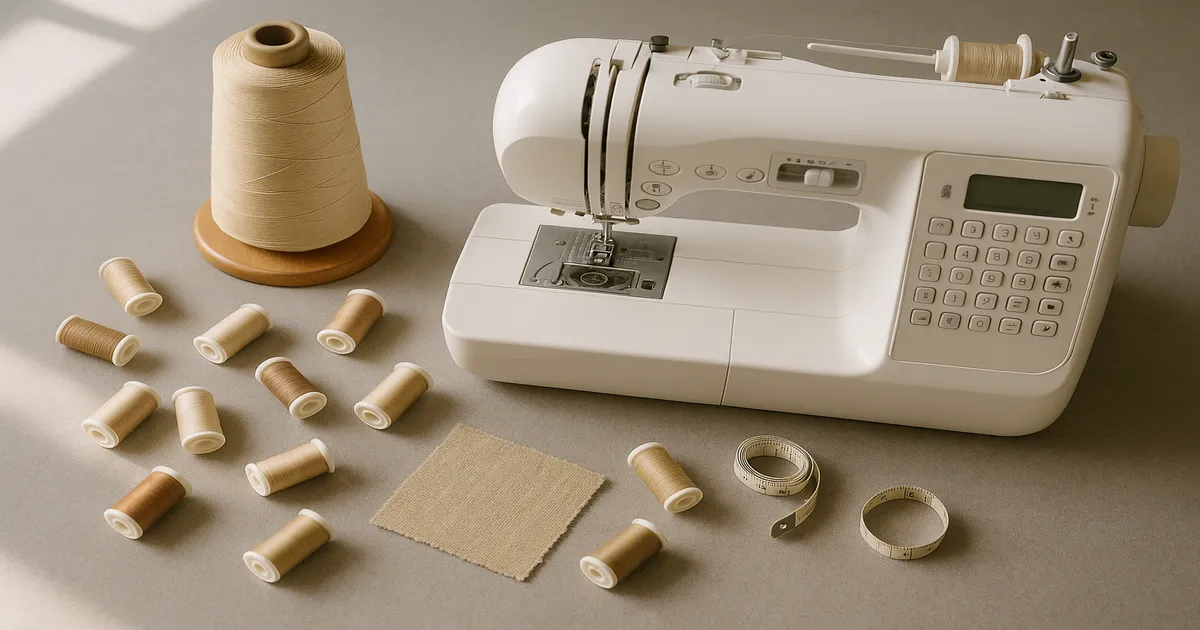
Quick Answer: Yes, your Brother NX400 sewing machine will work with 1000m thread — but the format matters more than the length. A large cross-wound spool will often sit right on the horizontal spool pin with no extra gear. A cone-shaped spool won’t, and needs a cheap external stand. Get that one thing right and the rest is easy.
If you’re staring at a bulk buy of 1000m thread and wondering whether it’ll work on your Brother NX400, the short answer is yes — usually. The longer answer is that “1000m thread” isn’t a single thing. It comes in at least two very different physical shapes, and that shape determines everything. Buy the wrong format and you’ll have tension problems before you finish your first seam.
Will 1000m Thread Work on the Brother NX400? (The Real Answer)
Large cross-wound spools — the ones that look like an oversized version of a regular spool — will often sit right on the NX400’s horizontal spool pin with no extra equipment. Cones, the tall tapered ones designed for sergers, need a vertical thread stand positioned behind the machine.
Neither situation is hard to deal with. But you do need to know which one you’re working with before you start.
Why Format Matters More Than Thread Length
The NX400’s spool pin is designed for spools that feed thread from the side as they spin horizontally. Cones feed from the tip downward — put one on a horizontal pin and it’ll wobble, tip over, and give you tension problems within the first few inches. The 1,000 meters of thread itself isn’t the issue. It’s the shape of what’s holding it.
Cones vs. Large Spools: How to Tell Them Apart
What You’re Actually Looking At
A cross-wound spool has parallel sides, like a standard spool just scaled up. Thread is wound in a criss-cross pattern so it feeds smoothly off the side as the spool rotates. A cone is tapered — wide at the base, narrow at the top — and thread unwinds from the tip downward when it stands vertically. They are not interchangeable on a domestic machine. Full stop.
Here’s a quick way to tell them apart by size:
- Large cross-wound spool: roughly 2–2.5 inches (50–63mm) in diameter, 3–4 inches (75–100mm) tall, parallel sides
- Cone: 3–4 inches (75–100mm) at the base, 4–6 inches (100–152mm) tall, distinctly tapered
If it looks like a miniature traffic cone, it’s a cone. If it looks like a stubby cylinder, it’s a spool.
Common 1000m Thread Brands and Their Formats
Gutermann sells 1000m on large parallel-sided spools that typically work directly on domestic machines. Coats & Clark uses spool format for most of their bulk thread too. Aurifil’s 1,094-yard (1,000m) options also come on large spools. Madeira and Rasant, on the other hand, are more commonly found on cones aimed at embroidery and serger users — those will need a stand.
What the Brother NX400 Spool Pin Can (and Can’t) Handle
The NX400 ships with two spool caps — small and large. The horizontal pin has an inner diameter of approximately 5/16 inch (8mm), and the maximum spool diameter it can comfortably handle is around 2.5 inches (63mm) with the large cap in place.
A 1000m cross-wound spool with a standard core hole will usually fit. Before you assume yours does, slide it onto the pin and check: it shouldn’t wobble side to side, and the spool cap should hold it snugly. If the core hole is slightly too large — which happens with some bulk spools — stuff a small roll of felt into the core to snug it up. Sounds hacky, but it works reliably.
Don’t put a cone on the horizontal pin. I’ve seen people try it. The cone sits at an angle, thread unwinds unevenly, and you get loops on the underside of your fabric within the first seam. Cones are engineered to stand vertically and feed from the tip — fighting that on a horizontal pin is a losing battle every time.
The NX400 does have a secondary vertical spool pin, and a very small cone might balance on it temporarily. But it’s not designed for the weight or geometry of a full 1000m cone. Use a stand.
How to Use a Thread Cone Stand with the Brother NX400
A basic universal thread stand runs $5–$20 and consists of a weighted base, a vertical rod, and a wire guide arm at the top. That’s genuinely all you need. Make sure the guide wire sits at least 6–8 inches (15–20cm) above your machine’s first thread guide once the stand is positioned — too low and you’ll get inconsistent tension as the feed angle changes.
Place the stand directly behind the machine, centered with the spool pin as closely as possible. The thread should travel in a straight, gentle upward arc from the cone tip through the wire guide and into the machine’s first thread guide. Any sharp sideways angle will cause tension issues.
Threading the NX400 from a Cone Stand
- Place the cone on the stand with the tip pointing up.
- Draw the thread up through the wire guide arm.
- Feed into the NX400’s first thread guide at the top of the machine.
- Continue the normal numbered thread path: tension discs → take-up lever → lower guides → needle.
- Use the automatic needle threader as usual for the final step.
One thing that trips people up: cones should unwind counter-clockwise when viewed from above. If your thread is twisting as it feeds, the cone is spinning the wrong direction — flip it.
Adjusting Tension When Using a Cone Stand
Start at the NX400’s default tension setting of 4. Because the thread travels a longer path from a cone stand than it would from the spool pin, the effective tension runs slightly looser. Bump it to 5 or 6, sew a test seam on the same fabric you’re using for your project, then hold the seam up to the light. The thread should lock invisibly in the middle of the fabric layers, not pulling toward either side.
Winding Bobbins from a 1000m Spool or Cone
The NX400 uses a Class 15 bobbin (also sold as the SA156) — approximately 7/16 inch (11mm) tall and 7/8 inch (22mm) in diameter. Standard domestic size, nothing exotic. You can wind directly from your 1000m source using the machine’s built-in bobbin winder, whether the thread is on the spool pin or coming off a cone stand.
Wind at moderate speed, not full throttle. Stop when the bobbin is 80–85% full — there should be a visible gap between the thread and the outer edge of the bobbin. An overfull bobbin binds in the bobbin case and causes thread jams and tension chaos. The 80–85% rule gives the thread room to move freely.
Pre-wind 4–6 bobbins before starting a large project. Stopping mid-seam to wind a bobbin is annoying; stopping mid-seam on a quilt border is genuinely demoralizing. Label each bobbin with a small sticker noting the thread color and weight — when you’ve got a drawer full of them, you’ll thank yourself.
Needle Selection for 1000m Thread on the Brother NX400
The most common 1000m thread weights are 40wt and 50wt all-purpose polyester or cotton — both work perfectly on the NX400. Match your needle to the thread:
| Thread Weight | Needle Size | Best Needle Type |
|---|---|---|
| 50wt cotton/poly | 70/10 or 75/11 | Universal or Microtex |
| 40wt all-purpose | 80/12 | Universal |
| 40wt quilting | 75/11 or 80/12 | Quilting needle |
| 30wt topstitch | 90/14 | Universal or Topstitch |
Replace your needle every 8–10 hours of sewing, or at the start of every new project. A dull needle causes more skipped stitches and tension problems than almost anything else — and it’s a 30-second fix.
Avoid heavy industrial threads — bonded nylon, thick upholstery thread — on the NX400. They stress the tension discs and can cause real mechanical damage over time. Stick to consumer-grade thread even in 1000m quantities.
Common Mistakes to Avoid
Putting a cone on the horizontal spool pin. It will not work. Use a stand.
Skipping the tension test seam. Sew at least 6 inches (15cm) on scrap fabric that matches your project before touching your actual material. Every time.
Overfilling the bobbin. Stop at 80–85%.
Ignoring thread direction on cones. Counter-clockwise from above. If it’s twisting, flip the cone.
Not using a felt spool pad. Large spools on the horizontal pin can spin too freely and unwind in bursts, creating loops. A 1-inch (25mm) felt disc under the spool adds just enough friction to smooth the feed.
Not snugging up a loose core hole. If your spool wobbles on the pin, roll a small piece of felt or foam and insert it into the core. Takes 30 seconds and solves the problem completely.
Four Ways to Use 1000m Thread on the Brother NX400
Option 1 — Large spool directly on the machine. If your 1000m thread is on a large parallel-sided spool with a standard core hole, put it on the horizontal pin with the large spool cap and a felt pad underneath. No extra equipment needed. This is the easiest path when the format cooperates.
Option 2 — External cone stand (recommended for cones). A $10 stand handles virtually any large thread format, takes two minutes to set up, and opens up the full range of 1000m options. This is what I’d recommend for anyone regularly buying bulk thread.
Option 3 — Wind down to standard spools. Use the NX400’s bobbin winder to transfer thread from the cone onto standard empty spools. Time-consuming for large quantities, but it works with no extra equipment.
Option 4 — Reserve 1000m thread for bobbin winding only. Honestly, this is a smart move for quilters. Bobbin thread disappears fast, and 1000m is excellent value for that purpose. Use the 1000m source purely for winding bobbins and keep standard spools on top. No compatibility headaches at all.
Frequently Asked Questions
Will my Brother NX400 sewing machine work with 1000m thread on a cone?
Yes, but not directly on the machine. You need an external vertical thread stand — a basic one costs $5–$20. Once the cone is on the stand and threaded through the guide wire into the machine’s normal thread path, it works fine. Just expect to nudge your tension up slightly (from 4 to 5 or 6) and run a test seam first.
What bobbin does the Brother NX400 use?
The Class 15 bobbin, also sold as Brother part number SA156. It’s approximately 7/16 inch (11mm) tall and 7/8 inch (22mm) in diameter — a standard domestic size available from most sewing retailers. Wind them to 80–85% full, not to the brim.
Can I use serger cone thread on the Brother NX400?
Yes, as long as the thread weight is appropriate for domestic use (40wt–50wt all-purpose). The thread itself is compatible; it’s just the delivery format that requires an external vertical stand. Put the cone on the stand, thread it through the guide wire into the machine’s normal path, and it works like any other thread.
Why is my tension off when using a cone stand?
The thread is traveling a longer distance than it would from a spool on the pin, which loosens the effective tension. Start at the NX400’s default setting of 4, increase to 5 or 6, and sew a test seam. Also check that the cone stand’s guide wire is at least 6–8 inches (15–20cm) above the machine’s first thread guide — if it’s too low, tension will be inconsistent.
What’s the difference between a thread cone and a large spool?
A cone is tapered — wide at the base, narrow at the tip — and designed to stand vertically, feeding thread downward from the tip. A large spool has parallel sides and feeds thread from the side as it rotates on a horizontal pin. Both can hold 1000m of thread, but they need completely different setups on a domestic machine like the NX400.