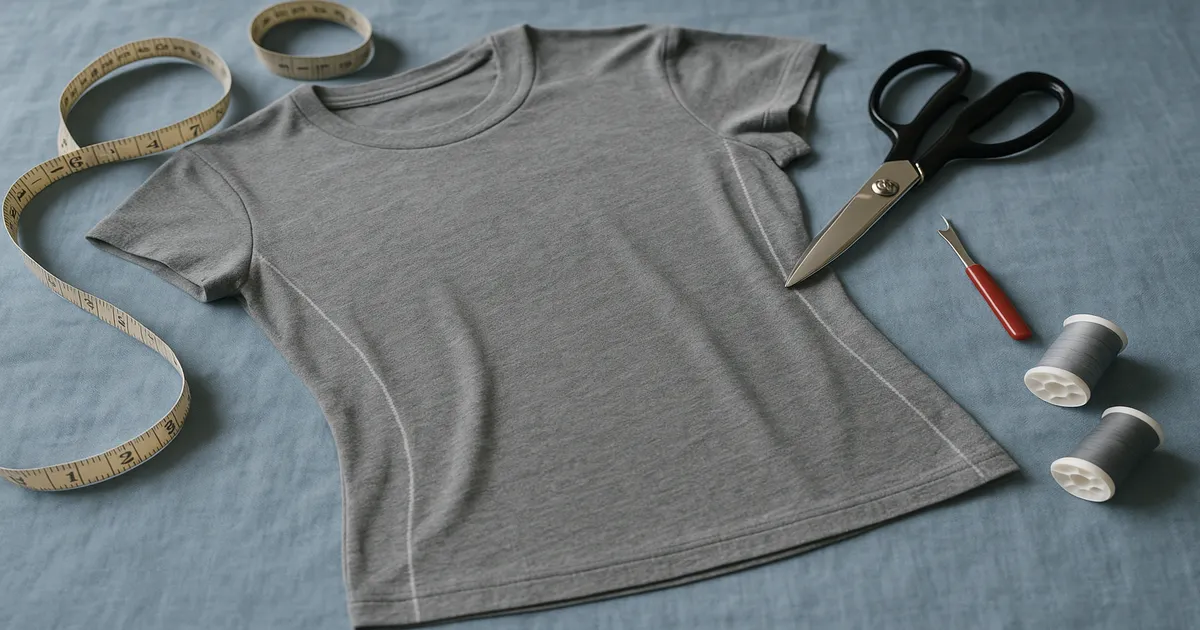
Quick Answer: To downsize a t-shirt while keeping it looking normal, trace new side seams using a well-fitting shirt as a template, sew with a stretch-appropriate stitch, and leave the original hem and neckline completely untouched. You’re only altering the side seams — everything else stays exactly as the factory made it.
If you’ve ever pulled on an oversized tee and thought “I wish this actually fit,” you already know the frustration. Learning how to downsize a t-shirt while keeping it looking normal is one of the most useful alterations you can pick up — and it’s genuinely doable at home, even without a serger. The catch is that jersey knit plays by different rules than woven fabric, and most attempts that end up looking obviously homemade come down to a handful of avoidable mistakes.
Why T-Shirt Resizing Is Trickier Than It Looks
Jersey knit — the fabric in virtually every t-shirt — stretches 50–100% horizontally and 25–50% vertically. That stretch is what makes it comfortable, but it also means cut edges curl, seams can wave, and a straight stitch will pop open the first time you pull the shirt over your head. You need stitches that move with the fabric, not against it.
The other thing that trips people up is knowing which parts to touch. The answer is simple: only the side seams (and sleeve seams if needed). The shoulder seams, neckline, and original hem are off-limits. Moving a shoulder seam throws off the entire sleeve geometry and produces that unmistakable “costume” look. And the original hem? It’s a coverstitch — two parallel rows of topstitching on the outside with a looped finish inside — and you can’t replicate it at home without a specialized coverstitch machine. Leave it alone and it looks factory-made. Cut it off and you’ll spend the rest of your time trying to fake something that never quite looks right.
How much can you realistically take in? One full size per pass is the sweet spot. Two sizes is doable but requires more care. Beyond that, you risk pulling a graphic off-center, distorting the silhouette, and ending up with sleeves that look comically wide. My practical limit: no more than 1.5–2 inches (38–51mm) per side seam in a single pass.
One more thing before you pick up scissors: pre-wash the shirt. Cotton jersey shrinks 3–5% in length and 1–3% in width on the first wash. Alter it dry and your new seams will distort the moment it hits the laundry.
Tools You Need Before You Start
Needles: Use a ballpoint or stretch needle — never a universal or sharp needle. A standard needle pierces jersey threads and causes runs, holes, and skipped stitches. Size 75/11 works for most tees; go up to 90/14 or 100/16 for heavier “beefy” fabric. Schmetz stretch needles are my go-to.
Thread: All-purpose polyester only. Cotton thread has no give and will break under stress.
Presser foot: A walking foot makes a real difference on stretchy fabric by feeding both layers evenly. If you have a serger, use it — a 4-thread overlock stitch is the best result you can get on knits. A narrow zigzag (width 1.0–1.5mm, length 2.0–2.5mm) on a standard machine works well too.
Cutting tools: Dull scissors are the enemy. Jersey drags and stretches under a dull blade and your cut lines end up ragged. A good pair of 8–10 inch fabric shears or a 45mm rotary cutter with a self-healing mat is what you want. Use fabric weights instead of pins to hold layers while cutting — they prevent shifting without distorting the fabric.
Marking and clipping: Tailor’s chalk or a washable fabric marker works fine. Wonder Clips instead of pins — they don’t distort stretchy fabric the way pins can. Round out the kit with a seam gauge, a steam iron, and a pressing cloth.
How to Downsize a T-Shirt While Keeping It Looking Normal: Step by Step
Step 1: Pre-Wash and Assess the Fit
Wash and dry the shirt on the settings you’ll normally use. Then put it on and figure out exactly what’s wrong: too wide through the body? Sleeves too boxy? Focus on body width first. Shoulder width is an advanced alteration — skip it for now.
Step 2: Use a Guide Shirt to Mark New Seam Lines
Find a t-shirt that fits you well. This is your template, and it’s the single most important tool in this whole process.
- Lay the guide shirt flat on a table, smoothed but not stretched.
- Lay the shirt to be altered on top, aligning the necklines and shoulder seams precisely.
- Clip the two shirts together at the shoulders so they don’t shift.
- Trace along the side seams of the guide shirt with chalk or a washable marker.
- Add a 5/8-inch (16mm) seam allowance outside your traced line — this is your cutting line.
If the sleeves need taking in, trace those too.
The flip-and-trace trick: After marking one side, fold the shirt in half (center front to center back) and trace through to the other side. This guarantees perfect symmetry and eliminates lopsided results. It takes 30 seconds and is absolutely worth it.
Step 3: Cut Accurately
Fold the shirt so the side seams align and cut both layers simultaneously — front and back together — for symmetry. Use sharp scissors or a rotary cutter. Do not cut the original hem. Your cutting line stops where the hem begins.
Step 4: Sew the New Side Seams
Pin or clip the new side seams right sides together, matching the underarm point carefully. Sew from the hem upward toward the armhole — this direction makes the underarm curve easier to manage. Use a narrow zigzag or your serger’s overlock stitch, not a straight stitch. Slow down at the underarm curve and let the machine feed the fabric at its own pace. Don’t pull or push.
Press the seam after sewing. This single step separates results that look store-bought from ones that look homemade.
Step 5: Adjust the Length (If Needed)
Try the shirt on before touching the hem. If it needs shortening, mark the new length, cut leaving 1 inch (25mm) for a double-fold hem, press the fold, and topstitch with a twin needle or a narrow zigzag. Stretch the hem fabric slightly as you sew to build in the necessary give.
Step 6: Final Fitting and Finishing
Put the shirt on and check the side seam placement — it should fall at the natural side of your torso, not toward the front or back. Clip the seam allowance at the underarm curve (small snips perpendicular to the seam, about every ½ inch/13mm, without cutting the stitch line) to release tension and let the curve lie flat. Give everything a final press.
Mistakes That Make Alterations Look Homemade
Using a straight stitch. It has zero stretch and will pop open under normal wear — sometimes the first time you pull the shirt on. Always use a zigzag, lightning bolt stitch, or serger.
Cutting off the original hem. I can’t stress this enough. The coverstitch hem is irreplaceable at home. Leave it intact and your alteration is invisible from the bottom.
Stretching the fabric while sewing. If you pull jersey through the machine, it stretches under the needle and relaxes into waves once it’s free. Hold the fabric lightly, use a walking foot, and let the feed dogs do their job. On a serger, set the differential feed to 1.2–1.5 to prevent this entirely.
Skipping the pre-wash or taking in too much at once. Pre-washing prevents post-alteration distortion. And taking in more than 1.5–2 inches (38–51mm) per side in a single pass risks pulling graphics off-center and making the shirt unwearably tight. Conservative passes you can always repeat — you can’t add fabric back.
Alternative Methods for Specific Situations
Side graphic tees: If the print runs along the side seam area, taking in from the sides will distort it. Add a center back seam instead — you’re removing width from the center back panel, which keeps side graphics intact.
Sleeve-only alteration: If you’ve taken in the body significantly, the sleeves often look disproportionately wide. Take in the sleeve seams by roughly half the amount you took in the body — so if you removed 1.5 inches (38mm) per body side seam, take in about ¾ inch (19mm) from each sleeve seam. Sew from the hem of the sleeve upward toward the underarm.
No-sew temporary fixes: Heat-activated hem tape can temporarily take in side seams — iron it between folded fabric layers. Safety pins work for a single event. Neither option survives repeated washing the way sewn seams do. They’re a stopgap, not a solution.
Frequently Asked Questions
Can I resize a t-shirt without a sewing machine?
You can, but the results are temporary. Heat-activated hem tape can hold a folded seam through a few washes before it starts to lift. Safety pins are fine for a one-time event. For anything meant to last, even an entry-level machine with a zigzag stitch will produce far more durable results than any no-sew method.
How do I make a t-shirt smaller without it looking altered?
Preserve everything the factory made: the original hem, the neckline, and the shoulder seams. Only alter the side seams. Use a well-fitting guide shirt as your template, match your thread color carefully, and press every seam. Done right, most people will just think the shirt fits you well — they won’t know you touched it.
Can you take in a t-shirt with a graphic on it?
Yes, as long as the graphic is centered on the front or back panel and doesn’t extend onto the side seams. If the print wraps around to the sides, use the center back seam method instead. And keep each pass conservative — taking in too much at once can pull even a centered graphic slightly off-center.
How many sizes can you take a t-shirt down in one alteration?
One full size is the practical sweet spot. Two sizes is possible with care. Beyond that, do it in two separate passes — sew, assess the fit, then take in more if needed. Trying to do it all at once is how you end up with something unwearable.
Why does my t-shirt seam look wavy after sewing?
Almost always because the fabric was stretched while sewing. Use a walking foot, hold the fabric without tension, and let the feed dogs move it at their own pace. If the waves are minor, a good press with steam can help flatten them out — but fixing your technique is the real answer.