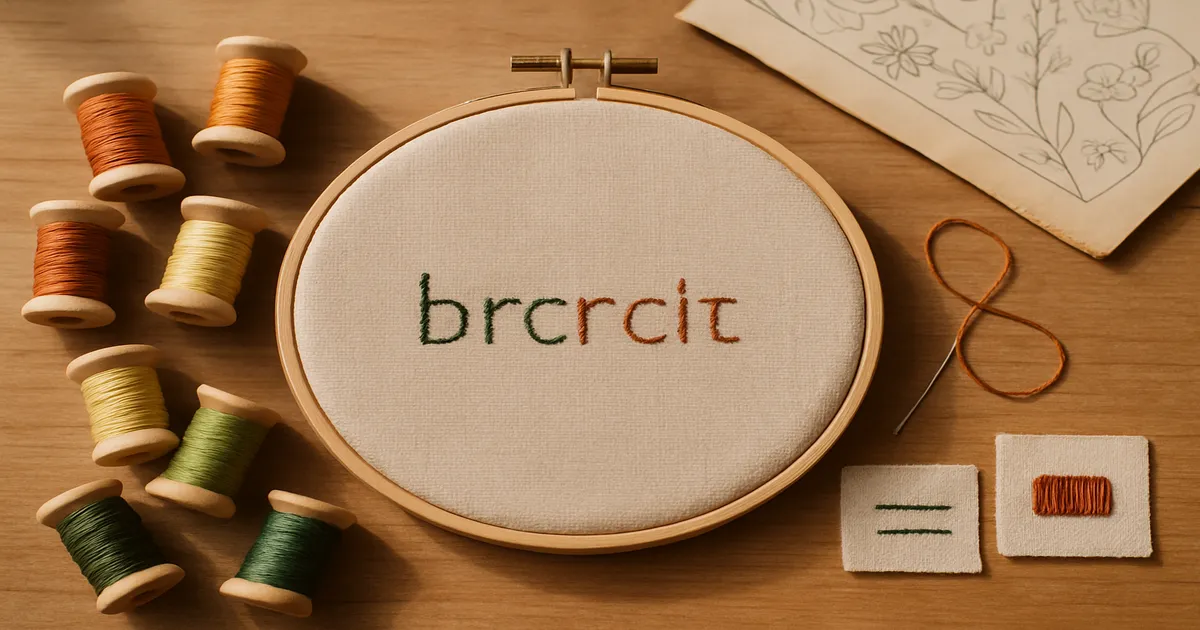
Quick Answer: Chicken scratch lettering almost always comes down to four fixable problems — skipping a transfer guide, using the wrong thread weight for your letter size, not stabilizing your fabric, and inconsistent stitch length. Fix those four things and your letters will look dramatically better, even on your next project.
If you’ve ever finished a piece of hand embroidery or machine lettering and thought “that looks like a kindergartner wrote it,” you’re not alone — and you’re definitely not bad at sewing. Making letters not look like chicken scratch is a real technical skill with specific, learnable steps. The frustrating part is that most tutorials skip the foundational stuff and jump straight to the pretty photos. This one won’t.
Why Sewn Lettering Looks Like Chicken Scratch (And Why It’s Not Your Fault)
A pen on paper is predictable. Thread on fabric is anything but. Thread responds to the grain of your fabric, the tension on your needle, and the pressure of your hand — all at once. Pull a stitch slightly too tight and the fabric puckers; the letter distorts. Even quilting cotton, which feels perfectly stable in your hands, will shift under a hoop unless it’s properly anchored. That shifting is what turns a clean “A” into a wobbly mess.
There’s also a typography angle most people never consider. The human eye reads text by looking for three things: consistent x-height (the height of lowercase letters like “a” and “e”), uniform baseline alignment, and predictable spacing between characters. When any of those three things goes wrong, text becomes hard to read — and looks like chicken scratch. Colonial American samplers were worked on evenweave linen specifically because the grid of the fabric enforced consistent letter proportions automatically. We can replicate that same principle with modern transfer tools.
One more thing beginners rarely hear until they’ve already made the mistake: letters smaller than ½ inch (13mm) tall are extremely difficult to execute cleanly in most hand embroidery stitches. The thread is just too thick relative to the letter shape. Bigger letters are genuinely easier. Start large.
Step 1: Design and Planning (The Part Everyone Skips)
Choose a Lettering Style That Matches Your Skill Level
Start with sans-serif block letters — clean, simple shapes with no decorative strokes. A block “A” is just three lines. A script “A” is a smooth curve, a loop, a connector stroke, and consistent slant all at once. Script is an advanced skill, not a beginner-friendly one. I know it looks beautiful on Pinterest, but save it for after you’ve nailed the basics. Aim for capital letters at least 1 inch (25mm) tall when you’re starting out.
Match Your Letter Size to Your Stitch Method
Different techniques have different minimums for readable text:
| Method | Minimum Readable Cap Height | Recommended Beginner Size |
|---|---|---|
| Cross-stitch on 14-count Aida | ~⅜ inch (9mm) | ½–¾ inch (13–19mm) |
| Hand embroidery (backstitch) | ¾ inch (19mm) | 1–1.5 inches (25–38mm) |
| Machine embroidery | 0.4 inch (10mm) | 0.5–1 inch (13–25mm) |
| Free-motion quilting | 1 inch (25mm) | 1.5–2 inches (38–51mm) |
Transfer a Guide — Every Single Time
This is the single most impactful change you can make today. Tracing a guide isn’t cheating. It’s what professionals do, every time.
- Light fabric: Print your letters at the correct size, then trace directly onto the fabric using a light box or a bright window and a water-soluble marking pen.
- Dark fabric: A chalk wheel or white marking pen works well here. Avoid wax-based chalk — it can leave permanent residue.
- The beginner game-changer: Sulky Sticky Fabri-Solvy is a printable, adhesive-backed water-soluble stabilizer. Print your letters directly on it, stick it to your fabric, stitch through both layers, then dissolve it in water. Clean letters, zero tracing required.
Step 2: Stabilization — This Is Where Most People Go Wrong
Hoop Your Fabric Drum-Tight
Your hooped fabric should feel like a drum head — taut and even, with no visible distortion of the grain. If the weave is pulling at an angle, your letters will too. Tighten the hoop screw fully, then gently tug the fabric edges to re-tension before you start stitching. For machine embroidery, always use the smallest hoop that fits your design. A letter floating in a large hoop has more room to shift.
Use the Right Stabilizer for Your Fabric
Stabilizer is non-negotiable. Even on quilting cotton, the act of stitching creates enough pull to distort letterforms without it.
- Quilting cotton / woven fabrics: Medium-weight tear-away stabilizer (Pellon Stitch-N-Tear)
- Knit or stretchy fabric: Cut-away only — tear-away will distort knits when you remove it
- Terry cloth / towels: Water-soluble topper laid over the surface prevents the loops from grabbing your thread (Sulky Solvy)
- Delicate or sheer fabric: Water-soluble topper prevents stitches from sinking into the weave
Step 3: Stitching the Letters — Technique by Method
How to Make Letters Not Look Like Chicken Scratch in Hand Embroidery
Backstitch is the best stitch for lettering outlines, full stop. Keep each stitch 1/16 to 1/8 inch (1.5–3mm) long — shorter on curves, slightly longer on straight runs. Consistent stitch length is what separates clean lettering from chicken scratch more than any other single factor.
Stem stitch gives a slightly raised, rope-like line that looks beautiful on text. Keep the working thread consistently to the same side on every stitch, or the twist goes irregular.
Split stitch produces a very smooth outline, excellent for smaller letters. Each stitch should be about 1/8 inch (3mm), splitting the previous stitch exactly in half.
Satin stitch for filled letters: always lay a split stitch or backstitch outline first. That outline acts as a wall that keeps your fill stitches aligned and gives the letter a crisp edge. Angle your satin stitches at 45 degrees to the letter’s vertical axis, and keep individual stitches under ¼ inch (6mm) or they’ll sag.
Machine Embroidery: Ditch the Built-In Alphabets
The built-in alphabets on most home embroidery machines are poorly digitized. They’re included as a selling feature, not because they produce great results. A properly digitized font from a reputable source will stitch out dramatically better. Set your stitch density between 0.4mm and 0.45mm for satin-stitch column letters, and always run a test stitch-out on scrap fabric with the same stabilizer before touching your actual project.
Free-Motion Quilting Text
Drop your feed dogs, attach a darning foot, and before you touch fabric, practice tracing each letter on paper. Your hand speed and machine speed need to stay in sync — when they don’t, you get gaps or thread buildup. Aim for 10–12 stitches per inch (25mm), which is a consistent, moderate pace for most machines.
Securing Thread Ends Invisibly
Use the waste knot method: knot your thread, insert the needle from the front about 1 inch (25mm) ahead in the direction you’ll stitch. Your working stitches will cover the thread tail on the back as you go. Clip the knot when you reach it. On the back, weave thread tails through at least 4–5 existing stitches before trimming.
Materials That Actually Make a Difference
Thread weight matters more than most people realize:
- 2 strands of DMC 6-strand floss — fine detail, letters under ¾ inch (19mm)
- 3 strands — standard lettering on quilting cotton, ¾ to 1.5 inches (19–38mm)
- 6 strands or Perle cotton #8 — bold letters, 1.5 inches (38mm) and up
- Perle cotton #12 — finer than #8; good for small letters on fine linen
- Machine thread: 40-weight for standard work; 60-weight for letters under ½ inch (13mm) to reduce bulk
Needles: For hand embroidery, a crewel needle size 7 or 8 handles 2–3 strands of floss well; size 5 or 6 for heavier thread. For machine work, a Schmetz Embroidery 75/11 handles standard 40-weight thread. For fine 60-weight thread on dense lettering, step down to a Schmetz Microtex 60/8.
Hoops: A hardwood hoop with a brass screw holds tension far better than cheap plastic ones. Elbesee and Edmunds are both solid choices. And don’t underestimate a good pair of small embroidery scissors — sharp points make a bigger difference than most people expect. Gingher 3.5-inch are the gold standard.
Best beginner fabrics: Quilting cotton is ideal — stable, takes transfer marks cleanly, easy to hoop. 14-count Aida cloth is excellent for cross-stitch lettering because the grid does half the consistency work for you. Avoid jersey knit, velvet, or anything with significant stretch until you’ve got solid fundamentals.
9 Mistakes That Create Chicken Scratch Lettering
- Skipping the transfer step. Without a guide, letter heights wander and the baseline drifts. Trace every time, no exceptions.
- Too many thread strands for the letter size. Thick thread on small letters creates lumpy, unreadable forms. For letters under ¾ inch (19mm), use no more than 2 strands.
- Attempting script too early. Master block letters first. Script will come faster than you think once you do.