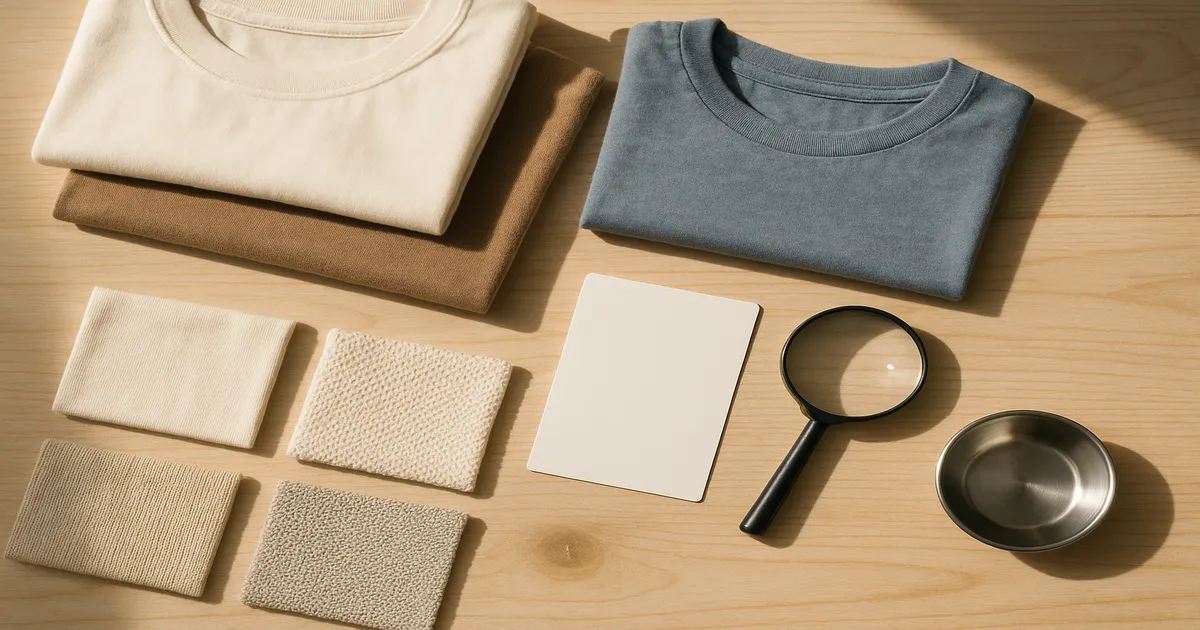
Quick Answer: Almost every t-shirt is a knit fabric, not a woven — and that single fact changes how you alter it. To figure out fabric type for a tee you want to alter, identify two things: the fiber content (cotton, polyester, rayon, or a blend) and the knit construction (jersey, interlock, rib knit). Start with the care label, then use the stretch test, burn test, and a few quick hand-feel checks to confirm. You can usually nail it in under ten minutes with no special equipment.
If you’ve ever sewn a seam on a t-shirt only to have it pop open the first time you put it on — or watched your iron leave a shiny melt mark on what you thought was a cotton tee — those aren’t technique failures. They’re identification failures. Figuring out fabric type for a tee you want to alter is the step most people skip, and it’s the reason most beginner alterations go sideways.
There are five reliable methods to identify any tee fabric. Use as many as you need until you’re confident.
How to Figure Out Fabric Type for a Tee: Start With These Two Questions
Before you touch a needle or an iron, you need to know two things: what the fabric is made of (fiber content) and how it’s constructed (knit structure). A care label gives you the first. The hands-on tests below give you both.
Fiber content is the raw material — cotton, polyester, rayon, modal, or some blend. Fabric construction is how those fibers are knitted together: jersey, interlock, rib knit, or French terry. These two things together determine your needle size, thread type, stitch choice, and iron temperature. Get either one wrong and you’re in trouble.
Step 1 — Read the Care Label
Check the left side seam, the back neck seam, or — on most tees made in the last decade — the inside back hem, where the content is printed directly on the fabric as a tagless label.
The label will list something like “100% Cotton,” “60% Cotton / 40% Polyester,” or “50% Cotton / 50% Modal.” In the U.S., the FTC has required accurate fiber content labeling since 1971, so trust the numbers. A 60/40 cotton-poly blend acts mostly like cotton but resists shrinking and wrinkles better.
Care symbols fill in the gaps. A wash tub with a low temperature (30°C / 86°F) often signals a delicate synthetic or rayon blend. A crossed-out iron or a single-dot iron setting is a dead giveaway for polyester content. The symbols won’t tell you the construction, but they’ll confirm your fiber suspicions.
Thrifted and vintage tees frequently have labels that are cracked, faded, or cut out entirely. That’s exactly when the tests below become essential.
Step 2 — The Stretch Test: Identify Knit Construction Fast
Lay a 4-inch (10 cm) section of the hem or side seam flat on a table. Stretch it firmly — not aggressively — and measure how far it extends. If 4 inches stretches to 6 inches, that’s 50% stretch. Simple math, useful result.
Two-way stretch (crosswise only) is standard on everyday tees. Four-way stretch — in all directions — is the telltale sign of a spandex or Lycra blend, even if the label lists only 2–5% elastane. That tiny percentage changes everything about how you sew it.
Here’s how to classify what you’ve got:
- Stable knit (under 25% stretch): Ponte, double knit, structured rib. Easiest to sew.
- Moderate stretch (25–50%): Standard cotton jersey — your everyday tee. Most common.
- Super stretch (75–100%+): Spandex blends, athletic tees. Needs a stretch needle and more patience at the machine.
Step 3 — The Burn Test for Unlabeled or Mystery Tees
Do this outside or next to an open window. You need metal tweezers, a fireproof dish or ceramic plate, a lighter, and a small cup of water nearby. Cut a 1-inch × 1-inch (2.5 cm × 2.5 cm) swatch from an interior seam allowance or the hem fold — somewhere that won’t leave a visible hole.
Hold the swatch with tweezers and bring it slowly toward the flame. Watch how it reacts to heat, how it burns, what it smells like, and what’s left behind.
| Fiber | Approaches Flame | Burns | Smell | Residue |
|---|---|---|---|---|
| Cotton | Doesn’t shrink away | Burns quickly, keeps burning | Burning paper | Soft gray ash |
| Polyester | Shrinks/melts away | Melts and drips | Sweet chemical/plastic | Hard black bead |
| Rayon/Viscose | Doesn’t shrink | Burns fast — faster than cotton | Burning paper | Almost no ash |
| Nylon | Shrinks away | Melts, self-extinguishes | Celery-like/chemical | Hard tan bead |
| Spandex/Lycra | Shrinks and curls | Burns and melts | Chemical/rubbery | Soft black ash |
| Modal/Bamboo | Doesn’t shrink | Burns like cotton | Burning paper | Soft gray ash |
Blends give you mixed signals — which is actually useful. A poly-cotton blend will drip a little, smell papery, and leave a semi-hard residue that’s not quite a clean bead. Muddled results almost always mean a blend: sew with polyester thread and keep the iron low.
Step 4 — Quick Field Tests: Water, Feel, and Visual Inspection
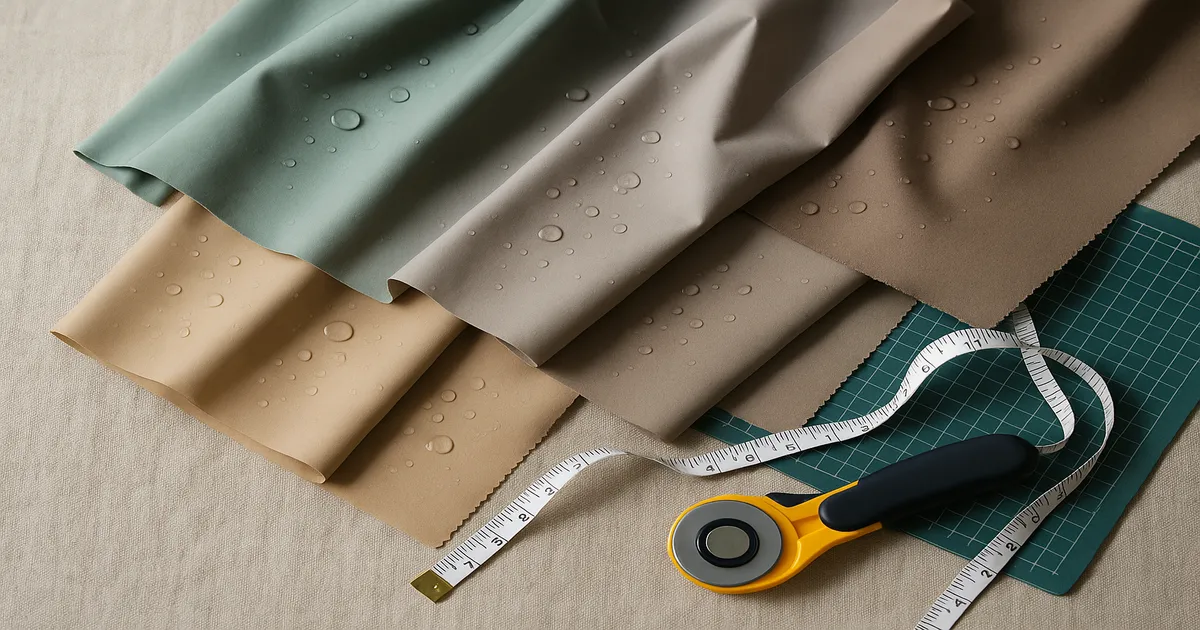
Water drop test: Put a small drop of water on the fabric. Natural fibers — cotton, rayon, modal — absorb it almost immediately. Polyester causes the water to bead up or absorb very slowly. This is the fastest way to distinguish rayon from polyester when both feel similarly soft and drapey.
Hand-feel test: Drag your fingernail firmly across the surface. Cotton feels slightly resistant and matte. Polyester feels slick and springs back immediately. Rayon has a heavy drape and a silky feel without the slipperiness of polyester. Modal is noticeably soft — almost buttery. If it feels like the nicest t-shirt you’ve ever touched, it’s probably modal.
Visual inspection: Hold the fabric up to a light source and look at the structure:
- Jersey: “V” pattern on the right side, looped texture on the wrong side
- Interlock: Looks the same on both sides — smooth V columns on each face, more stable, less prone to curling
- Rib knit: Alternating raised columns — common on neckbands and cuffs, occasionally used for the whole body on fitted tees
- French terry: Smooth outside, looped inside — common in sweatshirt-style tees
The curl test: Cut a 1-inch (2.5 cm) wide strip on the crosswise grain and let it hang. Jersey curls toward the right side — it can’t help itself, it’s a single-faced knit. Interlock won’t curl at all. This matters because interlock is more stable and forgiving to sew, while jersey needs a bit more care to keep from stretching out at the seam.
Fabric Identification Decision Tree
Is it a knit or a woven? Pull the fabric crosswise. If it stretches, it’s a knit — almost certainly what you’re working with. If it doesn’t stretch at all, you may have a woven tee (chambray shirts sometimes get mistaken for tees), and this guide doesn’t fully apply.
Is it stretchy?
├── NO → Likely a woven — double-check before altering
└── YES → It's a knit. Continue:
    ├── Stretches in all four directions?
    │   └── YES → Spandex/Lycra blend (athletic or fitted tee)
    └── NO → Two-way stretch. Continue:
        ├── Looks the same on both sides?
        │   └── YES → Interlock knit
        ├── V's on the front, loops on the back?
        │   └── YES → Jersey knit
        └── Raised ribbed columns?
            └── YES → Rib knit
Once you know the construction, layer in your fiber results:
- Burns like paper + soft ash + absorbs water fast → Cotton
- Melts/drips + hard black bead + water beads up → Polyester
- Burns fast + silky or drapey feel + absorbs water → Rayon or Modal
- Mixed burn results + semi-hard residue → Blend
Choosing the Right Tools Once You’ve Identified the Fabric
Needles
Never use a sharp universal needle on knits. The tip pierces the loops and creates runs — the fabric equivalent of a ladder in a stocking, and it’s not fixable. Always use a ballpoint/jersey needle for standard tees; the rounded tip pushes between loops instead of piercing them.
Size guide:
- 70/10: Lightweight jersey (120–140 GSM), fine rayon
- 75/11: Standard cotton jersey — the size you’ll reach for most often
- 80/12: Mid-weight jersey, French terry
- 90/14: Heavyweight or structured jersey
For spandex blends, switch to a stretch needle — it has a deeper scarf (the groove above the eye) that prevents skipped stitches on highly elastic fabric.
Thread
Use 40wt polyester thread on cotton jersey, polyester jersey, and rayon blends alike. I know the instinct is to match thread to fiber — cotton thread for a cotton tee — but cotton thread has no give and will snap the moment a knit seam gets stretched. Polyester thread has just enough elasticity to flex with the fabric. For spandex blends, wooly nylon in the bobbin gives you even more recovery.
Stitches and Pressing
A straight stitch has zero give — the first time someone pulls a tee over their head, the seam pops. Use a narrow zigzag (width 0.5–1.0 mm, length 2.5 mm), a lightning bolt stitch, or a serger. Most modern machines also have a dedicated stretch stitch — three stitches forward, one back — which works well for side seams.
A walking foot is worth every penny for knit sewing. It feeds both layers at the same rate and prevents the stretching and puckering that a standard presser foot causes. For slippery polyester, a Teflon-coated foot reduces drag.
When pressing, always use a pressing cloth on polyester and poly blends. Polyester melts and glazes at cotton iron settings (above 300°F / 150°C). Set your iron to the synthetic/low setting and test on a seam allowance first. Cotton jersey loves steam; polyester does not.
Common Mistakes to Avoid
Skipping the pre-wash. Cotton jersey shrinks 5–10% in the first wash. Alter first, wash later, and you’ll end up with a garment that suddenly doesn’t fit. Always pre-wash using the same method you’ll use going forward.
Stretching the fabric while sewing. Jersey is eager to stretch, and any tension you apply while guiding it through the machine creates permanent wavy seams. Let the machine feed the fabric. Your hands should guide, not pull.
Cutting or sewing off-grain. The lengthwise knit columns (wales) need to run straight up and down the body. Cut off-grain and the tee will twist and spiral when worn — and there’s no fixing it after the fact.
Pro Tips for Faster Identification
The snap-back test for spandex: Stretch the fabric firmly and let go. Pure cotton jersey recovers slowly and may not fully return to its original shape. Spandex-blend fabric snaps back immediately and completely. Even 2–5% elastane makes a dramatic difference — and tells you that you need a stretch needle and wooly nylon thread.
Build a swatch book: After you identify a fabric, cut a 2-inch × 2-inch (5 cm × 5 cm) swatch, tape it to an index card, and record the fiber content, stretch percentage, needle size, stitch type, and iron setting. After working through 20 or 30 tees, you’ll have a personal reference library that makes identification nearly instant. I’ve been doing this for years and it’s genuinely one of the most useful habits I’ve built.
Thrifted and vintage tees: Faded labels are the norm with secondhand garments. The burn test becomes your best tool — reliable fiber information even when the label is completely gone. Older garments are more likely to be 100% cotton and less likely to contain synthetics, but don’t count on it.
Frequently Asked Questions
How can I tell if a tee is cotton or polyester without a label?
The burn test is most reliable: cotton burns like paper and leaves soft gray ash; polyester melts, drips, and leaves a hard black bead. Back it up with a feel test (cotton is matte and slightly rough; polyester feels slippery with a subtle sheen) and a water drop test (polyester beads up rather than absorbing).
What’s the difference between jersey and interlock for alterations?
Jersey has a “V” pattern on the right side and a looped texture on the wrong side — it curls at cut edges and is slightly less stable. Interlock looks the same on both sides, doesn’t curl, and is more forgiving to sew. For alterations, interlock holds its shape better and is less likely to stretch out at the seam. If you’re new to knit sewing, interlock is the friendlier starting point.
Do I need a special needle to alter a t-shirt?
Yes, and this one’s non-negotiable. A ballpoint or jersey needle has a rounded tip that pushes between knit loops instead of piercing them. A sharp universal needle causes runs that can’t be repaired. For tees with any spandex content, use a stretch needle instead — it handles the extra elasticity without skipping stitches.
Why do my t-shirt seams pop open after altering?
Almost certainly a straight stitch. It has no give, so the moment the knit stretches, the thread snaps. Switch to a narrow zigzag (0.5–1.0 mm wide, 2.5 mm long), a lightning bolt stitch, or a serger. Also check your thread — cotton thread breaks under stretch; polyester thread flexes with it.
Can I alter a t-shirt on a regular sewing machine, or do I need a serger?
A regular machine works fine. Use a ballpoint needle, polyester thread, and a narrow zigzag or built-in stretch stitch. A walking foot helps a lot with feeding the fabric evenly. A serger gives you a cleaner, more professional finish and trims the seam allowance in one pass — but it’s a nice-to-have, not a requirement.