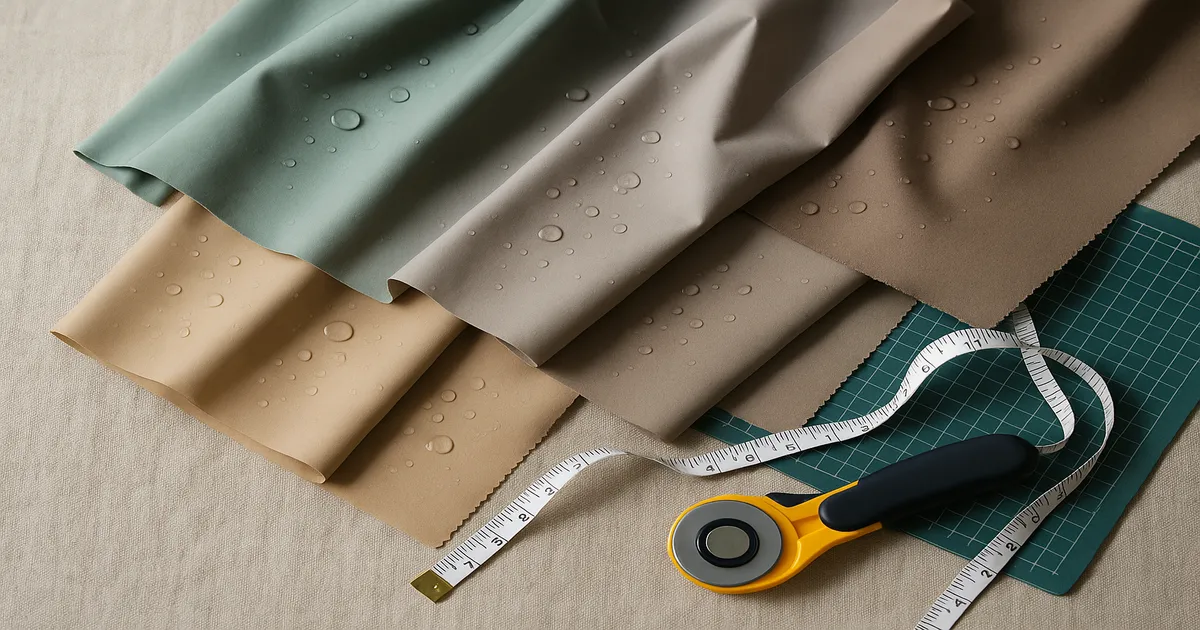
Quick Answer: That soft fabric with the slightly plasticky back is almost certainly PUL (polyurethane laminate) — but it could also be TPU, laminated fleece, softshell, coated ripstop nylon, waxed cotton, or neoprene. Each achieves waterproofing differently, and each has its own sewing quirks. Use the diagnostic steps below to identify yours, then jump to the sewing section.
If you’ve ever picked up a fabric that feels soft and drapey but has a slightly plasticky back, you’ve already stumbled into the answer to “what is this fabric — waterproof but soft?” It’s a fair question, because modern waterproof fabrics look nothing like the stiff rubber raincoats of your childhood. What replaced those is a range of materials that use thin membranes, polyurethane laminates, and engineered coatings to keep water out without feeling like a bin bag.
The short version: waterproof and soft aren’t opposites anymore. But not all soft waterproof fabrics are equal, and picking the wrong one for your project will cost you — either in leaks, or in a sewing experience you’d rather forget.
What Makes a Fabric Waterproof AND Soft?
The trick is separating the job of “blocking water” from the job of “feeling comfortable.” In older waterproof materials, one layer had to do both — and it usually did neither particularly well. Modern fabrics solve this by layering: a soft face fabric handles comfort and drape, while a thin film or coating handles waterproofing. The two layers are bonded together (laminated) so they behave as one fabric.
There are three main approaches:
- Lamination — bonding a waterproof film (PUL, TPU, ePTFE) to a knit or woven backing
- Chemical coating — applying polyurethane or silicone directly to a woven fabric (coated ripstop nylon)
- Wax or oil treatment — saturating natural fibers with wax (waxed cotton/oilskin)
Soft Waterproof Fabric Comparison
| Fabric | Construction | Softness | Truly Waterproof? |
|---|---|---|---|
| PUL | Knit or woven + PU film | High | Yes |
| TPU Laminate | Knit or woven + TPU film | Medium-High | Yes |
| Gore-Tex | ePTFE membrane + face fabric | High | Yes |
| Softshell | Woven outer + fleece inner ± membrane | Very High | Often water-resistant only |
| Coated Ripstop Nylon | Woven nylon + PU or silicone coating | Medium | Yes (at higher coating weights) |
| Waxed Cotton | Woven cotton + wax treatment | Medium | Water-resistant |
| Neoprene | Foamed synthetic rubber | Medium | Yes |
| Laminated Fleece | Fleece + waterproof membrane | Very High | Yes |
Waterproof vs. Water-Resistant vs. Water-Repellent
These three terms get used interchangeably in fabric shops and product listings, and that’s a genuine problem because they mean different things.
Water-repellent is a surface treatment — usually DWR (Durable Water Repellency) — that causes water to bead and roll off. It works great in light rain, but under sustained pressure or a heavy downpour, water eventually pushes through. Most “outdoor” jackets start here.
Water-resistant means the fabric resists penetration briefly or under low pressure. Tightly woven canvas, for example. Fine for a quick drizzle, not for sitting on wet ground.
Waterproof means the fabric prevents water penetration even under sustained hydrostatic pressure. This is what you need for cloth diapers, wet bags, and serious rain gear.
What Is a Hydrostatic Head Rating?
The hydrostatic head rating tells you how waterproof a fabric actually is. A column of water is placed over the fabric, and the height at which water begins to penetrate is recorded in millimeters.
- 1,500mm — minimum threshold for “waterproof”
- 5,000–10,000mm — good rain gear and ski jackets
- 10,000mm+ — serious technical outdoor gear
- PUL for cloth diapers typically rates at 1,500–3,000mm, which is plenty for that use case
For a cloth diaper or wet bag, 1,500mm is sufficient — the fabric isn’t being subjected to rain pressure, just containing liquid. A rain jacket hood needs at least 10,000mm if you’re actually going to wear it in a downpour. Higher-rated fabrics are often stiffer and trickier to sew, so there’s no point over-engineering a tote bag.
The 8 Main Types of Soft Waterproof Fabric
PUL (Polyurethane Laminate): The Sewist’s Favourite
PUL was developed in the 1980s for medical and incontinence applications and found its way into home sewing through the cloth diaper community. It’s made by bonding a thin polyurethane film to a knit or woven fabric backing — soft, stretchy in the knit-backed version, and genuinely waterproof.
It’s the easiest waterproof fabric to sew at home, which is why it dominates diaper and wet bag patterns. The main limitation is heat sensitivity — high temperatures in the wash or dryer will delaminate it. Wash at max 104°F / 40°C and tumble dry on low only.
Best for: Cloth diapers, wet bags, bibs, mattress protectors, waterproof pillow covers.
TPU Laminate: The Cleaner Alternative
TPU (thermoplastic polyurethane) replaced PVC-based laminates in many applications during the 2000s as environmental concerns about plasticizers grew. It’s similar to PUL in construction but without some of the chemical concerns, and it tends to be slightly more durable. If you’re making products for babies or anything food-contact, TPU is worth the small price premium. It’s slightly harder to find than PUL, but specialty suppliers stock it reliably.
Best for: Same applications as PUL; preferred where chemical-free materials matter.
Gore-Tex and ePTFE Membranes: The Technical Standard
Bob Gore accidentally discovered expanded PTFE (ePTFE) in 1969 by rapidly stretching a PTFE rod — the result was a membrane with billions of microscopic pores, each too small for liquid water but large enough for water vapor. That’s what makes Gore-Tex breathable as well as waterproof.
It’s the benchmark for technical outdoor gear, but it’s expensive, hard to source for home sewing, and requires seam sealing with specific heat-activated tapes. Not a starting point for most sewists.
Best for: Technical rain jackets, hiking gear, high-performance outdoor apparel.
Softshell: Soft but Often Only Water-Resistant
Softshell is genuinely one of the most comfortable fabrics you can sew with — typically a three-layer construction with a woven polyester face, a fleece or jersey backer, and sometimes a membrane in between. Stretchy, warm, beautiful drape.
The catch: most softshell is water-resistant, not truly waterproof. Unless the spec sheet explicitly mentions a waterproof membrane and a hydrostatic head rating, assume it’ll handle light rain but won’t stand up to a sustained downpour.
Best for: Jackets, vests, outdoor activewear, soft structured carriers.
Coated Ripstop Nylon: Lightweight and Packable
Ripstop nylon gets its characteristic grid pattern from reinforcing threads woven at regular intervals — this stops tears from spreading. A polyurethane or silicone coating on top provides waterproofing. It’s the fabric behind ultralight backpacks, packable rain jackets, and stuff sacks.
Silicone-coated versions (silnylon) are more durable and waterproof but are notoriously slippery, and seam tape won’t adhere to them — which limits your finishing options. PU-coated ripstop is easier to sew and seal. Denier (D) tells you the thread weight: 30D is ultralight and delicate, 210D is robust for bags.
Best for: Packable rain gear, backpack covers, outdoor bags, stuff sacks, tarps.
Waxed Cotton and Oilskin: The Natural Option
Waxed cotton is cotton canvas saturated with a paraffin or beeswax blend. It’s water-resistant rather than truly waterproof, but it has a beautiful aged patina and is repairable with a wax bar. It’s heavy (6–10 oz per square yard / 200–340 gsm), doesn’t stretch, and must be spot-cleaned only — machine washing strips the wax. The smell of new oilskin is distinctive and not everyone loves it.
Best for: Waxed canvas bags, hats, traditional outdoor jackets, tool rolls.
Neoprene: Stretchy and Submersion-Ready
Neoprene is foamed synthetic rubber — the same material used in wetsuits. Genuinely waterproof, stretchy in all directions, and excellent thermal insulation. Unlike other waterproof fabrics, it doesn’t need seam sealing because the material itself is the barrier; water can only enter through openings, not through the fabric itself. It’s bulkier and heavier than most other options. Sewing it requires a stretch needle and absolutely no iron — ever.
Best for: Wetsuits, laptop sleeves, drink koozies, waterproof pouches, swimwear accessories.
Laminated Fleece: Maximum Softness with a Membrane
Laminated fleece bonds a waterproof or water-resistant membrane to the back of a fleece fabric. The result is incredibly soft on the fleece side and protected on the back. The fleece face makes it hard to identify as waterproof at a glance — check the back for a smooth membrane layer.
Best for: Baby jackets, carrier covers, soft outdoor blankets, waterproof hat linings.
How to Identify a Soft Waterproof Fabric: 5-Step Diagnostic
You’ve got a mystery fabric. Here’s how to figure out what it is.
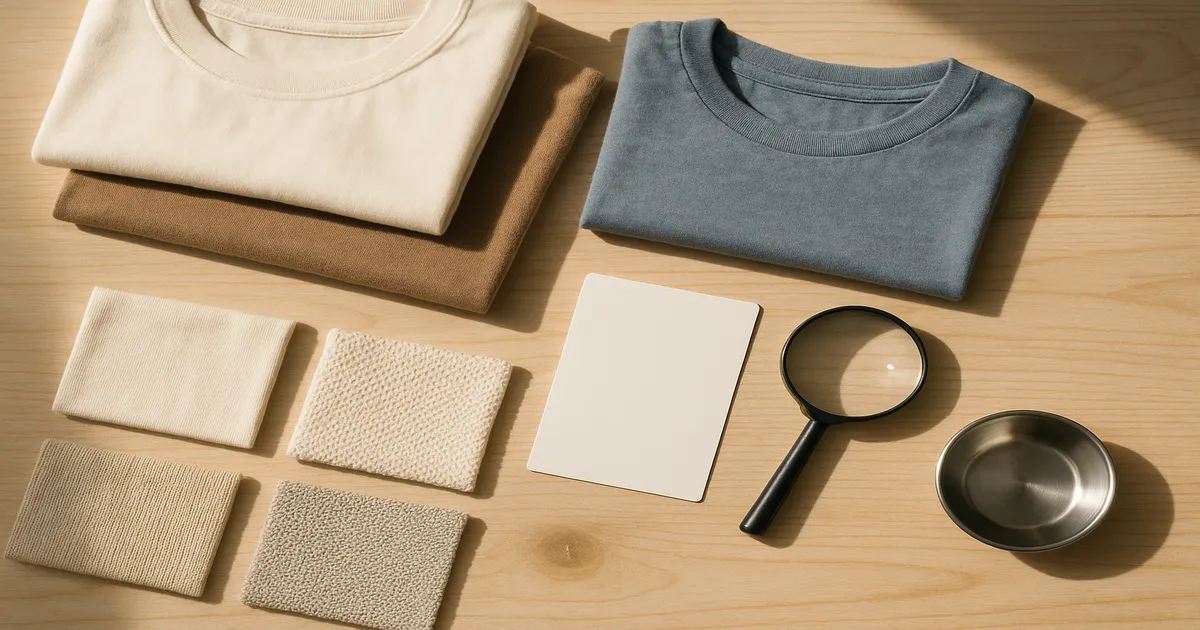
Step 1 — Feel both sides. Run the fabric through your fingers and check each side independently. Smooth and slightly plasticky on one side, soft fabric on the other → PUL or TPU laminate. Uniformly stretchy and spongy → neoprene. Waxy or slightly greasy all over → waxed cotton. Fluffy on one side, smooth film on the other → laminated fleece or softshell. Soft and drapey with a subtle sheen, no distinct second layer → coated nylon or polyester.
Step 2 — The water drop test. Drop a single bead of water onto the surface and watch for 60 seconds. If it beads up immediately and the back stays completely dry, you’ve got a true waterproof laminate. If it sits briefly then absorbs, it’s water-resistant at best.
Step 3 — Hold it to the light. A distinct second layer or film visible through the face fabric confirms laminated construction — PUL, TPU, or Gore-Tex. A uniformly tight weave with no visible second layer suggests a coated or treated fabric.
Step 4 — The stretch test. Stretches in all directions (4-way) → knit-backed PUL, neoprene, or laminated jersey. Stretches only on the bias → woven-backed laminate. No stretch at all → coated woven fabric (ripstop nylon, oilskin, waxed cotton).
Step 5 — The smell test. This sounds silly, but it’s one of the faster ways to distinguish PUL from coated nylon. New PUL and TPU have a faint plastic smell. Waxed cotton smells waxy and slightly oily. Neoprene has a rubbery smell that fades with washing. No smell at all usually points to a DWR-treated woven fabric.
How to Sew Soft Waterproof Fabric
Pre-Washing
- PUL and TPU: Wash in warm water (max 104°F / 40°C) before cutting to pre-shrink the knit backing. Tumble dry on LOW only.
- Waxed cotton: Do not machine wash. Spot clean only.
- Coated ripstop nylon: Skip pre-washing unless your supplier specifies otherwise.
- Neoprene: Cold wash to remove manufacturing residue.
Cutting
Scissors drag and distort laminated fabrics. Use a sharp rotary cutter on a self-healing mat — an Olfa 45mm rotary cutter is the standard choice for good reason. Cut single layers when possible, since laminates can stick to each other and shift. Use pattern weights instead of pins; pins leave permanent holes in the waterproof layer.
Marking
A Hera marker leaves a crease line with no ink, making it ideal for marking on the fabric side. Chalk also works well on the fabric side. Avoid water-soluble markers on laminate — they can leave residue.
Machine Setup
- Needle: Ballpoint or stretch 75/11–80/12 for knit-backed PUL; microtex 70/10–80/12 for coated nylon; stretch or universal 90/14 for neoprene and waxed cotton. Change your needle every project — laminates dull needles fast, and a dull needle skips stitches and can delaminate PUL.
- Stitch length: 3.0–3.5mm minimum. Shorter stitches perforate the fabric like a dotted line and destroy waterproof integrity.
- Tension: Test on scraps first. Laminates often need slightly loosened upper tension.
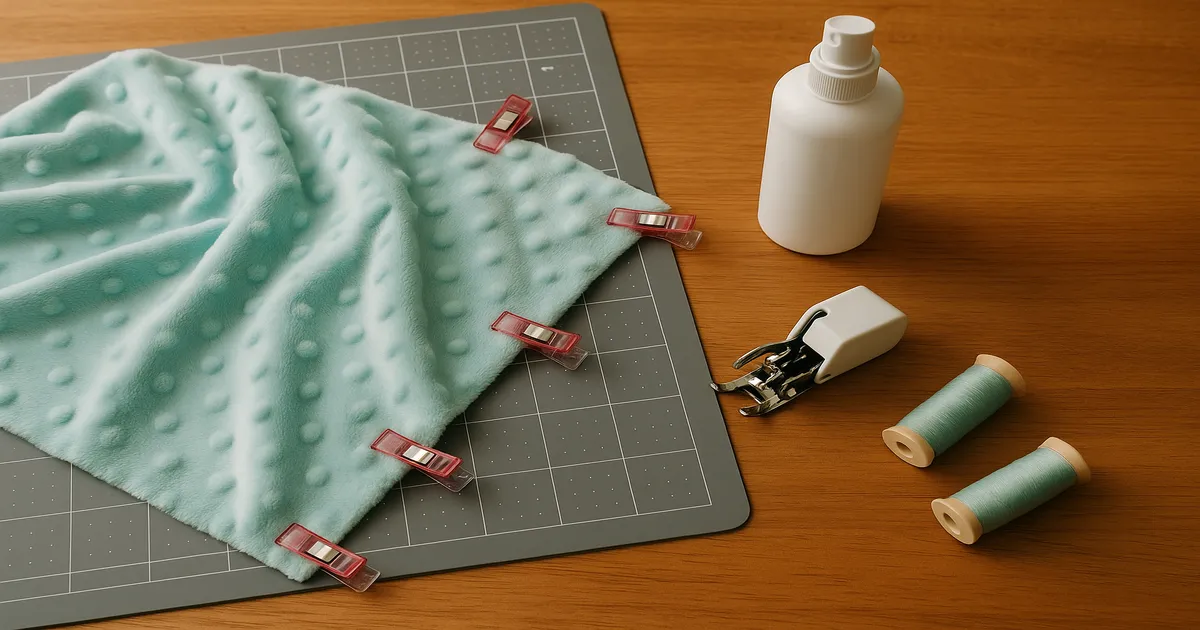
- Presser foot: Walking foot or Teflon foot. Non-negotiable.
- Thread: 100% polyester, weight 40. Cotton thread absorbs water and will eventually rot in anything that gets wet regularly.
Sewing Technique
Sew with the laminate or coated side face-down against the feed dogs — they grip it better than the presser foot can. Don’t backstitch at the start and end of seams; this punches multiple holes in the same spot and weakens the waterproof layer. Instead, use a locking stitch (2–3 stitches in place) or leave long thread tails and tie them off by hand.
Seam Finishing
This is the step most people skip, and it’s why their “waterproof” project leaks. Needle holes allow water through. Serging the seam edges is fine for neatness, but it does nothing to seal the seam itself.
For truly waterproof seams, apply iron-on seam sealing tape (½ inch / 12mm wide) over the seam on the inside using a pressing cloth and the lowest heat setting. Alternatively, paint seam sealing liquid over the seam allowance on the inside and allow it to cure fully before use.
Pressing
Never iron directly on PUL, TPU, or coated nylon. The laminate will melt, bubble, or fuse to the iron — and that damage is permanent. If you need to press a seam, use a pressing cloth and the absolute lowest heat setting with no steam. For most PUL projects, finger-pressing is enough. Neoprene doesn’t need pressing at all; seams lie flat on their own.
Frequently Asked Questions
Can I use a regular sewing machine for waterproof fabric? Yes — you don’t need a special machine. What you do need is the right foot (Teflon or walking foot), the right needle (ballpoint or stretch for PUL, microtex for coated nylon), and a longer stitch length. Most waterproof sewing failures come down to foot and stitch length, not the machine itself.
Why does my PUL project still leak after sewing? Almost always the seams. Stitching leaves needle holes, and water finds them. You need to seal seams with iron-on seam tape or seam sealing liquid — sewing alone won’t make a project waterproof, no matter how good your stitching is.
Is softshell fabric actually waterproof? Most softshell is water-resistant, not waterproof. It’ll handle a light drizzle but not a sustained downpour. If you need true waterproofing, look for softshell that explicitly lists a hydrostatic head rating of 1,500mm or higher on the spec sheet.
What’s the difference between PUL and TPU fabric? Both are laminated fabrics with a polyurethane-based film bonded to a knit or woven backing. TPU (thermoplastic polyurethane) is generally considered the cleaner option — it doesn’t contain the plasticizers found in some PUL formulations, making it preferable for baby products and food-contact items. In practice, they sew almost identically.
Can waterproof fabric go in the dryer? PUL and TPU can go in the dryer on LOW heat only — high heat causes delamination. Waxed cotton should never go in the dryer (or the washing machine). Coated ripstop nylon and neoprene are best air-dried. When in doubt, check your fabric supplier’s care instructions before you cut into anything.