Quick Answer: Transitioning to a full quilt means working through four phases — completing your quilt top, building the quilt sandwich, quilting all three layers together, and binding the edges. A full/double quilt top measures roughly 80 × 96 inches (203 × 244 cm), with a finished size of 78–86 × 87–95 inches (198–241 cm) once bound. The process is always the same: press, piece, baste, quilt, bind.
Knowing how to transition to a full quilt sounds straightforward until you’re standing over a wrinkled quilt top at 10 p.m. wondering what comes next. There’s a clear order of operations, and once you’ve done it once, the whole thing clicks. Here’s exactly how to get there.
Phase 1 — Completing and Squaring Your Quilt Top
Press Every Seam Before Joining Blocks
This is the step most people rush, and it costs them later. Press seam allowances to one side — toward the darker fabric is the traditional rule — using a dry iron at the cotton setting (around 400°F / 204°C). Skip the steam; it distorts bias edges. Press from the wrong side first, then flip the block over and press from the right side to flatten any pleats hiding in the seam.
Sewing Blocks into Rows
Use a consistent ¼-inch (6 mm) seam allowance throughout. Even a 1/32-inch deviation compounds fast — across 100 seams, that’s a 3-inch size discrepancy. Chain piecing (feeding block after block through the machine without cutting the thread between them) saves time and keeps you from accidentally sewing the wrong blocks together. At intersections, nest your seam allowances so they oppose each other; this reduces bulk and makes matching much easier.
Joining Rows and Matching Seam Intersections
Pin every seam intersection when you join rows. Match center points first, then work outward. If one row is slightly longer than another, ease the fullness by pinning every 2–3 inches (5–8 cm) — don’t stretch the shorter row to fit.
Squaring the Quilt Top
Once all rows are joined, lay the top flat on the floor and measure diagonally corner to corner in both directions. Those two measurements should be within ¼ inch (6 mm) of each other. If they’re not, the top is skewed and it won’t lie flat — ever. Trim uneven edges with a long ruler and rotary cutter until you have a true rectangle.
Phase 2 — Building the Quilt Sandwich
Choosing and Preparing Your Batting
Unroll your batting 24–48 hours before you need it so the wrinkles relax. It should extend 3–4 inches (8–10 cm) beyond the quilt top on all sides — the standard packaged full-quilt size of 81 × 96 inches (206 × 244 cm) works for most full-size tops.
Batting choice matters more than most beginners expect:
- Cotton (Warm & Natural): Best for hand quilting; shrinks slightly for that classic antique crinkle
- 80/20 blend (Hobbs Heirloom): The most popular all-purpose choice — good drape, slight shrinkage, plays well with both hand and machine quilting
- Polyester (Hobbs Poly-Down): Lightweight, no shrinkage, forgiving quilting distance up to 8–10 inches (20–25 cm)
- Wool (Hobbs Tuscany): Luxurious drape and natural temperature regulation, but pricier
If you’re not sure, go with the 80/20. It’s the workhorse of quilt batting for a reason.
Cutting and Seaming the Quilt Backing
For a full quilt, you need a backing roughly 86–88 × 102–104 inches (218–264 cm). Standard quilting cotton is 44–45 inches wide, so plan on 5.5–6 yards (5–5.5 m) seamed into two or three panels. Always remove the selvages before seaming — they’re woven tighter than the rest of the fabric and will pucker. Press backing seams open to reduce bulk.
If you’d rather skip the seaming entirely, 108-inch (274 cm) wide backing fabric is a genuine time-saver and worth every extra cent.
How to Baste a Full-Size Quilt
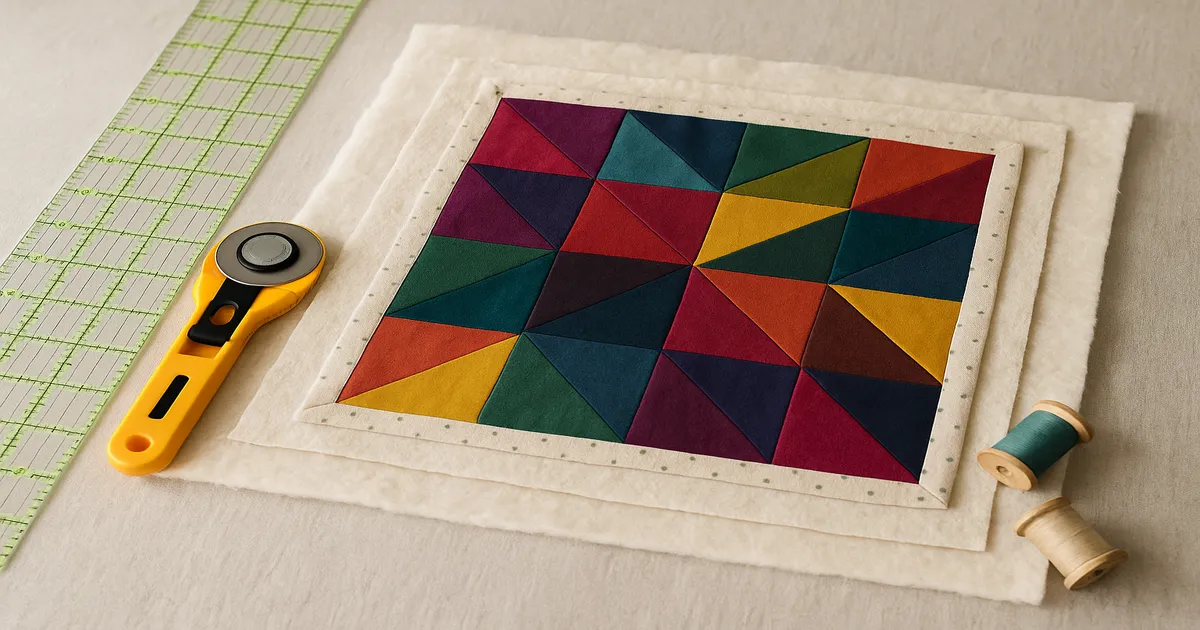
Layer in this order: backing face-down, batting, quilt top face-up. Smooth each layer from the center outward before securing anything.
- Thread basting — Long needle, white thread, 4-inch (10 cm) grid. Best for hand quilting.
- Safety pin basting — Size-1 curved safety pins every 4–6 inches (10–15 cm). You’ll need 350–500 pins for a full quilt. Best for machine quilting.