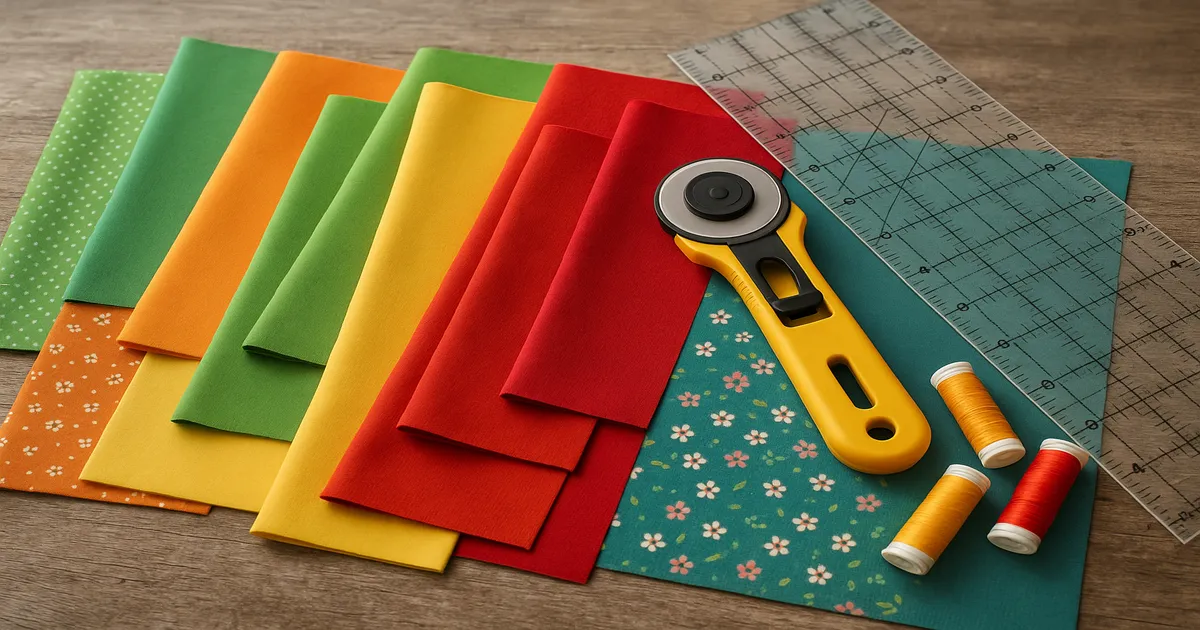
Quick Answer: Whether a fabric will work for binding comes down to three things: grain, weight, and how it behaves when pressed. Most woven fabrics can work with the right adjustments — but burlap, polyester satin, and loosely woven fabrics are the ones worth avoiding. Bias-cut strips handle curves; straight-grain strips are fine for straight edges.
So you’re standing at your cutting table holding a piece of fabric and asking yourself, will this work for binding? Maybe it’s a gorgeous vintage scrap, or a linen you’ve been hoarding, or something completely non-traditional. The stakes feel high because binding is the last thing you do — and nobody wants to ruin a finished quilt at the final step.
Here’s the good news: you can answer that question yourself in about ten minutes with a few simple tests. This guide walks you through exactly how to evaluate any fabric for binding, which materials work brilliantly, which ones will make you miserable, and how to apply double-fold binding cleanly from start to finish.
Will This Work for Binding? The Three-Factor Test
Every fabric’s suitability for binding comes down to the same three things:
- Grain — how the fabric behaves when pulled in different directions
- Weight — whether it folds to a manageable thickness
- Pressability — whether it holds a crease or springs back the moment you lift the iron
Most woven fabrics pass all three. The ones that reliably fail are loosely woven fabrics (they fray aggressively), slippery synthetics like polyester satin (won’t press, won’t behave), and anything so stiff or bulky it won’t fold cleanly to a ¼-inch (6mm) finished edge.
Bias Cut vs. Straight Grain: Which Do You Need?
Straight-grain binding — strips cut selvage to selvage — is efficient and perfectly fine for straight edges and most quilts. Bias binding, cut at a 45-degree angle, has a gentle stretch that eases around curves without puckering. If your project has rounded corners, necklines, or armholes, bias is the right call. For everything else, straight grain works beautifully.
How to Test Any Fabric for Binding: 5 Steps
Step 1: Check the Grain
Cut a test strip 2 inches × 10 inches (5cm × 25cm). Pull it lengthwise — almost no give. Pull crosswise — a little give is fine. Pull on the diagonal — it should stretch noticeably and recover. This tells you which grain to cut on and whether the fabric will ease around curves.
Step 2: Do the Fold Test
Fold the strip in half lengthwise, then in half again — mimicking double-fold binding. Press it flat. If it’s thicker than ¼ inch (6mm) or refuses to stay folded, mitering corners is going to be a fight. The sweet spot for most binding is 2–4 oz per square yard. You can go heavier for bags, but you’ll want single-fold construction.
Step 3: Test for Fraying
Cut a 2-inch (5cm) bias square and rub the edges briskly between your fingers for ten seconds. Minimal fraying? You’re good. Moderate fraying? The fabric can still work — just bump your seam allowance from ¼ inch (6mm) to ⅜ inch (9.5mm). Heavy fraying is a red flag; back it with fusible interfacing or choose something else.
Step 4: Press a Sample Strip
Press the strip at the correct temperature for that fiber. If it holds a crisp crease, great. If it springs back, binding application is going to be frustrating and the finished edges will look sloppy. Quilting cotton, linen, and cotton-linen blends press beautifully. Polyester needs a pressing cloth and steam — and even then, it’ll never behave like cotton.
Step 5: Pre-Wash and Check for Bleeding
Wash a 6-inch × 6-inch (15cm × 15cm) swatch, dry it, and measure. Shrinkage up to 3% is acceptable — roughly ⅛ inch per 4 inches (3mm per 10cm). Then press the damp swatch against white cloth and check for color transfer. Any fabric that bleeds needs repeated washing until it’s colorfast. Don’t skip this on dark fabrics or hand-dyed cloth.
Which Fabrics Actually Work for Binding?
The Good Stuff
100% quilting cotton is the gold standard — presses crisply, frays minimally, folds to a predictable thickness. It’s the default for a reason. Cotton-linen blend adds texture and works especially well on linen projects. Batik cotton is tightly woven with minimal fraying, though it can be slightly stiff. Flannel is soft and lovely, but cut your strips ¼ inch (6mm) wider than usual to account for the extra bulk.
Workable With Caveats
- Voile/lawn: Delicate and drapey — fine for lightweight garments, not ideal for quilts
- Knit/jersey: Cut on the crosswise grain for stretch; skip pressing and finger-press instead; works surprisingly well on knit garments
- Silk dupioni: Frays heavily — back it with lightweight fusible interfacing and reserve it for dry-clean-only projects
- Denim: Too bulky for double-fold; use single-fold only and expect a thick seam
- Leather/faux leather: No fraying at all, which is genuinely great; use Wonder Clips instead of pins, a Teflon presser foot, and a walking foot for even feeding
Fabrics to Skip
Burlap frays so aggressively that even interfacing doesn’t fully solve it. Polyester satin is slippery, won’t press, and shifts under the presser foot — it’s a miserable experience and the results show it. If you need a shiny finish, use a satin-weave cotton instead.
Cutting Binding Strips Correctly
Straight-Grain Strips
For standard double-fold binding, cut strips 2¼ to 2½ inches wide (57–64mm). If your batting is thicker than ½ inch (12mm), go up to 2¾ inches (70mm). Cut selvage to selvage — each strip yields roughly 40–44 inches (101–112cm) of usable binding from standard 44-inch (112cm) fabric.
Bias Strips
Fold your fabric so the selvage aligns with a crosswise cut edge and press that diagonal fold — that’s your true bias line. For double-fold bias binding, cut strips 2 to 2½ inches (51–64mm) wide. Bias strips stretch 15–20% when handled, so cut them longer than you think you need. A bias tape maker tool will save you significant time if you’re making more than a yard or two.
Joining Strips Without Bulk
Always join strips at a 45-degree diagonal seam — never straight across. Lay two strips right sides together at a 90-degree angle, draw a diagonal line from corner to corner, sew on the line, trim to a ¼-inch (6mm) seam allowance, and press open. Trim the little dog-ear points. This distributes the bulk across a longer span so it’s invisible from the front.
Applying Double-Fold Binding: Step by Step
Prepare Your Strip
Fold the entire joined strip in half lengthwise, wrong sides together, raw edges aligned, and press the full length. Don’t skip this press — a floppy strip is hard to control. A light coat of spray starch before pressing gives the strip a crispness that makes mitering corners noticeably easier.
Sewing It On
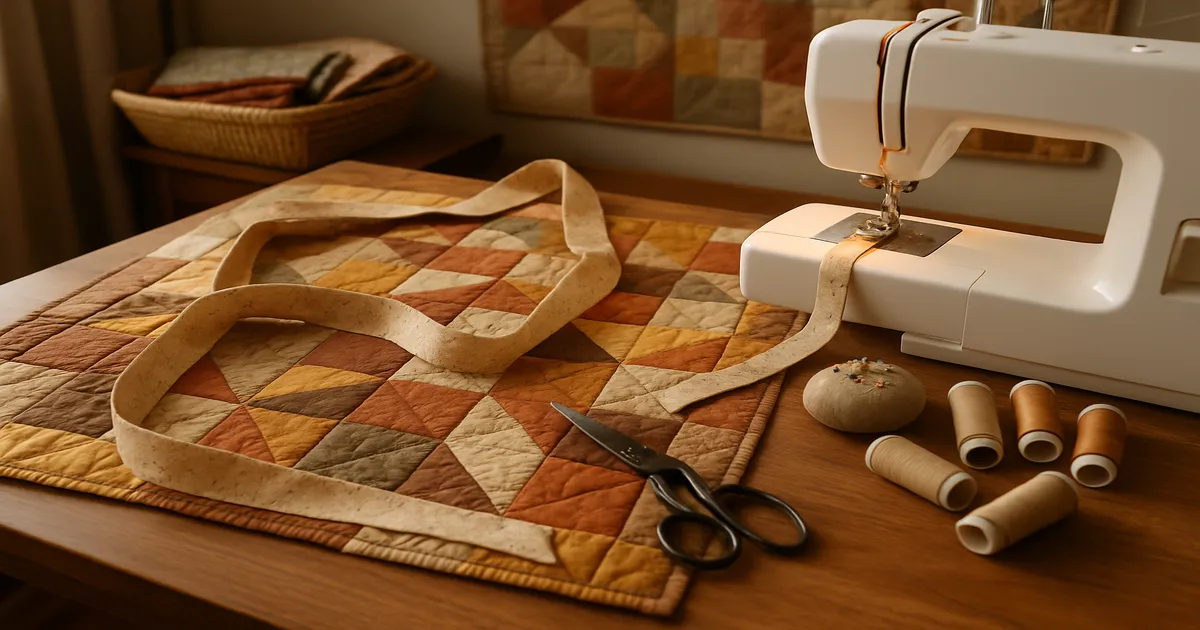
Start in the middle of one side — never at a corner. Leave a 6-inch (15cm) tail unsewn. Align the raw edges of the binding with the raw edge of the quilt top and sew with a scant ¼-inch (6mm) seam allowance at a 2.5mm stitch length. “Scant” means just a thread’s width shy of ¼ inch — when the binding folds over to the back, the fold itself eats a tiny bit of fabric, and that scant seam compensates exactly.
Mitering Corners
Stop exactly ¼ inch (6mm) from the corner — mark it with a fabric pencil before you start if that helps. Backstitch 3 stitches and remove the quilt from the machine. Fold the binding up at a 45-degree angle away from the quilt, then fold it back down so the new fold is flush with the top edge and the raw edge aligns with the next side. Resume sewing from the very top edge. It feels fussy the first time; by the tenth quilt, it’s automatic.
Joining the Ends
When you’re about 12 inches (30cm) from your starting point, stop. Overlap the two binding ends by 2½ inches (64mm) and cut. Open both ends flat, join them right sides together at a 45-degree angle, sew with a ¼-inch (6mm) seam, trim, press open, refold, and complete the seam. There are good video tutorials for this specific step if the written version isn’t clicking — it’s one of those things that’s much clearer in motion.
Finishing the Back
Hand stitching with a blind or ladder stitch gives the cleanest finish. Use thread matched to the binding fabric, keep lengths to 18 inches (46cm) or shorter, and wax the thread with beeswax to prevent tangling. If you prefer machine finishing, stitch-in-the-ditch from the front: the stitching lands in the seam line and catches the binding on the back. It’s faster and nearly invisible when your seam allowance is consistent.
Tools Worth Having
You don’t need much, but the right tools make a real difference:
- Rotary cutter — the 45mm size handles binding strips easily
- Self-healing cutting mat and a 6-inch × 24-inch quilting ruler
- ¼-inch quilting foot — non-negotiable for consistent seam allowances
- Walking foot — highly recommended for sewing through multiple quilt layers
- Wonder Clips for holding binding before hand stitching — genuinely better than pins on thick quilts
Common Binding Mistakes (and Quick Fixes)
Not pre-washing binding fabric. Skip it and the binding will shrink after the first wash, causing visible puckering along every edge.
Cutting strips too narrow. Strips at 2 inches (51mm) don’t leave enough fabric to wrap cleanly to the back. Default to 2¼ to 2½ inches (57–64mm).
Joining strips with a straight seam. Creates a lump of bulk that’s visible from the front. Always use a 45-degree diagonal seam.
Starting at a corner. The join between your binding ends will land right at the corner, creating a mess. Start 6–8 inches (15–20cm) from any corner.
Using straight-grain binding on curved edges. It will ripple and refuse to lie flat. Any curve tighter than about a 6-inch (15cm) radius needs bias-cut strips.
FAQ: Will This Work for Binding?
Can I use fat quarters for binding? Yes — cut them into strips on the crosswise grain. A single fat quarter (18 inches × 22 inches / 46cm × 56cm) yields roughly 80–90 inches (200–230cm) of binding, enough for a small lap quilt.
Can I use ribbon or trim as binding? Grosgrain ribbon works on lightweight projects like bags and pouches. It won’t miter cleanly, so stick to square corners. Avoid satin ribbon — it shifts and won’t press.
My binding keeps flipping to the front on the back side. What am I doing wrong? Almost always a seam allowance issue. If your seam is even slightly over ¼ inch (6mm), there isn’t enough fabric to wrap fully to the back. Try a true scant ¼ inch and see if that fixes it.
How much binding do I need for a standard quilt? Add up the perimeter of your quilt and add 12–15 inches (30–38cm) for joining and corners. A typical 60-inch × 80-inch (152cm × 203cm) lap quilt needs about 295 inches (750cm) of binding — roughly ⅓ yard (30cm) of 44-inch fabric cut into strips.
Does pre-made bias tape work as well as homemade binding? For garments and small projects, packaged double-fold bias tape is perfectly fine. For quilts, most quilters prefer to cut their own — the fabric matches the quilt, the weight is right, and the finished result looks more intentional.