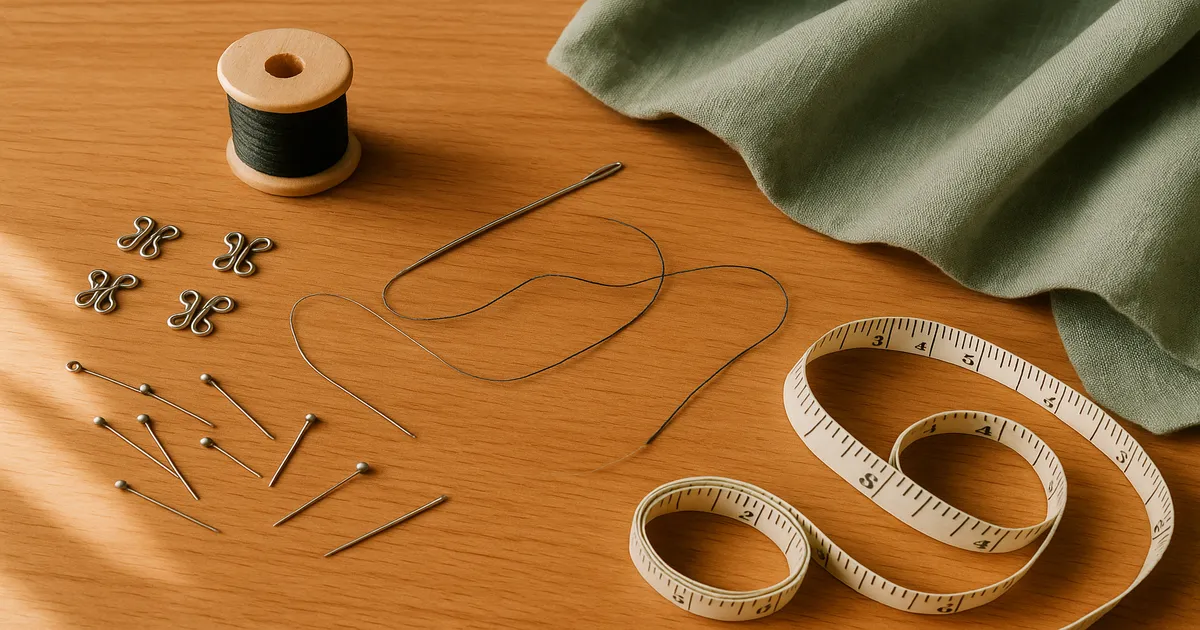
Quick Answer: To sew a hook and eye, position the hook on the wrong side of the fabric with the bill sitting 1/16–1/8 inch (1.5–3mm) back from the finished edge. Secure each ring with 8–12 blanket stitches, then tack the bill with 3–4 stitches. Mark the eye placement using the hook itself, then stitch the eye the same way. The whole process takes 10–15 minutes per closure and requires nothing more than a needle, doubled waxed thread, and the hardware.
Learning how to sew hook and eye closures by hand is one of those skills that looks fiddly until you understand the logic behind it — then it becomes fast, satisfying, and genuinely useful. These little fasteners show up everywhere: the top of a zipper, the back of a wedding dress, a tailored waistband. Done well, they’re invisible from the outside and hold under real tension. Done badly, they pop open, pull through the fabric, or create a lumpy ridge. The difference almost always comes down to a few technique details that most tutorials gloss over.
What Is a Hook and Eye Closure and When Should You Use One?
A hook and eye set has exactly two pieces: a metal hook (the curved part with a flat bill at the base) and an eye (either a round loop or a straight bar). The hook catches into the eye to hold two fabric edges together. The genius of the system is that the closed hook sits completely flat and below the fabric surface — invisible from the outside in a way that a button or snap simply can’t match. Hook and eye closures handle lateral tension far better than buttons, and they don’t add bulk. That logic is why they’ve been a staple of tailoring for centuries, and it’s still why they’re the right choice today.
Round Eye vs. Straight Bar Eye: Which Do You Need?
This is where a lot of beginners go wrong, and the fix is simple once you know it.
- Round eye (loop eye): use this when the two fabric edges meet (abutted closure). The loop extends just beyond the edge so the hook can swing in cleanly.
- Straight bar eye: use this when one edge overlaps the other (lapped closure). The bar sits flush with or just beyond the edge of the underlap.
Using a round eye on a lapped closure causes the hook to engage at an angle — it’ll gap and eventually fail. Match the eye type to the closure style, every time.
Hook and Eye Size Chart
| Size | Hook Width | Common Application |
|---|---|---|
| 0 | 3/8 in (9mm) | Delicate necklines, veils, bridal |
| 1 | 1/2 in (13mm) | Blouses, lightweight dresses |
| 2 | 5/8 in (16mm) | Dresses, skirts — the everyday workhorse |
| 3 | 3/4 in (19mm) | Waistbands, structured bodices |
| 4 | 1 in (25mm) | Heavy coats, corsets, outerwear |
When in doubt, go up a size rather than down. A hook that’s slightly larger than necessary will hold; one that’s too small for the stress level will bend and fail.
Materials and Tools
Thread
Thread choice matters more than most people think.
- Silk thread (size A or 50wt) for delicate fabrics — charmeuse, chiffon, fine wool. It has natural give and a fine diameter that won’t leave marks.
- Polyester all-purpose thread (50wt) for cotton, linen, and mid-weight fabrics. Gutermann Sew-All is my go-to; Coats & Clark works too.
- Heavy-duty polyester or nylon thread for denim, canvas, or corsetry where the closure will be under sustained tension.
Whatever thread you use, wax it. Run the doubled strand across a beeswax block and press it between paper towels with a warm iron. The heat melts the wax into the fibers rather than just coating the surface, cuts tangling dramatically, and makes the finished stitches noticeably stronger. This is not optional — it genuinely changes the experience of hand sewing.
Needles
- Size 9–10 sharps for lightweight to medium fabrics
- Size 7–8 sharps for heavier fabrics like denim or canvas
- Size 10–12 beading needle for size 0 hooks, where the rings are tiny
Before you thread the needle, test that it passes through the hook ring comfortably. If you’re forcing it, go smaller.
Hardware
Dritz and Prym are the reliable names. Avoid the very cheap sets — the metal is soft and bends after a few wearings. Finish options are silver/nickel (most common), black (better on dark fabrics), and gold (bridal and formal wear). Match your thread to the fabric, not the hardware — silver hardware wrapped in navy thread on a navy dress disappears completely.
Interfacing
For lightweight or knit fabrics, cut a 1-inch (2.5cm) square of cotton organdy or sew-in interfacing and slip it behind the closure area before you sew. This stops the stitches from eventually pulling through. Skip the fusible interfacing here — it creates a stiff ridge that’s visible from the outside and makes hand stitching harder. Cotton organdy is the couture choice: nearly weightless, minimal bulk, genuinely strong.
How to Sew a Hook and Eye: Step-by-Step
Prepare the Fabric First
Press the fabric edge before you do anything else. Any wrinkle or fold will translate directly into a misaligned closure once it’s sewn down. If you’re placing a column of multiple hooks, mark all positions at once with a seam gauge before you sew the first one — measuring each individually leads to cumulative drift, and uneven spacing is immediately noticeable.
Sewing the Hook
Step 1: Position the hook. Place it on the wrong side of the overlap, bill facing toward the fabric edge. The bill should sit 1/16 to 1/8 inch (1.5–3mm) back from the finished edge — far enough that it won’t show from the outside, close enough that the hook can still engage cleanly. For a waistband, position it 1/8 inch (3mm) below the top finished edge.
Step 2: Thread and wax your needle. Cut 18–24 inches (45–60cm) of thread — longer than that and it tangles and weakens from friction. Double it, wax it, press it, and tie a quilter’s knot at the end (wrap the thread around the needle three or four times, then pull the needle through the wraps).
Step 3: Blanket stitch each ring. Bring the needle up through the fabric from the wrong side, emerging inside one of the two rings at the base of the hook. Work a blanket stitch around the ring: insert the needle under the ring and through the fabric, pass the needle through the thread loop, pull taut. Repeat all the way around. Aim for 8–12 stitches per ring, evenly spaced, all going in the same rotational direction. Changing direction mid-ring creates uneven tension and looks sloppy. The finished stitches should form a neat raised ridge — that ridge is both structural and, honestly, satisfying to look at.
Step 4: Tack the bill. After both rings are stitched, bring the needle up at the tip of the bill and work 3–4 small tack stitches across it to hold it flat. This step gets skipped constantly, and it’s exactly why hooks lift and catch on other fabric. Don’t skip it.
Step 5: Finish securely. Bring the thread to the wrong side and weave the tail through at least 1/2 inch (13mm) of existing stitches before trimming. Don’t knot on the surface — surface knots create bumps and catch on fabric.
Sewing the Eye
Step 1: Mark placement using the hook itself. Don’t measure independently — you’ll introduce error. Close the hook over the fabric edge where the eye will go and press firmly with your thumbnail or a blunt stylus to leave a small indentation. That’s your center mark. Alternatively, rub tailor’s chalk on the tip of the hook bill and press it against the eye fabric — it leaves a mark at the precise contact point.
For a round eye, center the loop at that mark with the loop extending 1/16 inch (1.5mm) beyond the fabric edge. For a bar eye, position it flush with or 1/16 inch (1.5mm) beyond the edge.
Step 2: Stitch the eye rings. Same technique as the hook: 8–12 blanket stitches per ring, consistent direction, firm but not constricting. For a round eye, be careful not to pull the loop inward with your stitches — it needs to extend cleanly beyond the edge so the hook can actually get into it. If the loop gets pulled inward, the closure will pop open under any stress.
Step 3: Check alignment before finishing. Close the hook into the eye and hold the garment up to the light. Check that the edges align as intended, that there’s no pulling or puckering, and that the closure lies flat from the outside. This takes 30 seconds and has saved me from having to unpick and redo more times than I’d like to admit. Once you’re satisfied, weave in the tail.
Common Mistakes (and How to Avoid Them)
Too few stitches. Four or five stitches per ring looks fine on the worktable and fails after a few wearings. Eight is the minimum; twelve is better for anything under tension.
Skipping the bill tack. The ring stitches alone don’t keep the hook flat. Without those 3–4 tack stitches across the bill, the hook lifts, catches on other fabric, and eventually works loose.
Wrong eye type. Round eye on a lapped closure causes angled engagement and gapping. Bar eye on an abutted closure means the hook can’t engage at all. Match the eye to the closure style.
Hook bill too close to the edge. The bill should sit at least 1/16 inch (1.5mm) back — never flush with the finished edge. Flush means visible from the outside.
Skipping interfacing on lightweight fabrics. On chiffon, organza, or knits, the stitches will eventually pull through without a stabilizing patch behind them. Cut a 1-inch (2.5cm) square of cotton organdy, slip it behind the closure point, and sew through it as part of the attachment.
Wrong size hardware. A size 0 hook at a waistband will bend and fail. Size up for high-stress applications.
Pro Tips for a Professional Finish
Spacing a column of hooks. Space them 1/2 to 3/4 inch (13–19mm) apart. Closer than 1/2 inch and the stitching gets crowded; farther than 3/4 inch and the fabric gaps between closures. Mark every position before sewing the first hook.
Bar tack bridge for high-stress closures. For waistbands and corsets, add a thread bar tack across the base of the hook — between the two rings and the bill — before you stitch the rings. This distributes stress across a wider area of fabric instead of concentrating it at two points. It’s a professional tailoring technique and it dramatically extends the life of the closure.
Machine zigzag shortcut. If you’re sewing a full column of hooks on a production run, a machine zigzag (width 2.0–2.5mm, near-satin stitch density) over the rings is faster and perfectly functional for casual garments. Use an embroidery foot for visibility. The machine can’t easily reach the hook bill, so finish that part by hand regardless.
Frequently Asked Questions
What stitch do you use to sew a hook and eye?
The blanket stitch — sometimes called a buttonhole stitch in this context — is the right stitch for attaching hook and eye closures by hand. Work it around each ring, passing the needle through a thread loop before pulling taut to create a raised, wrapped edge. Aim for 8–12 stitches per ring.
Which side of the fabric does the hook go on?
The hook is sewn to the wrong side of the overlap — the side that sits on top when the closure is fastened. The bill faces toward the fabric edge, positioned 1/16 to 1/8 inch (1.5–3mm) back from the finished edge so it doesn’t show from the outside.
What’s the difference between a round eye and a straight bar eye?
A round eye is for abutted closures, where the two fabric edges meet — the loop extends just beyond the edge so the hook can engage cleanly. A straight bar eye is for lapped closures, where one edge overlaps the other. Using the wrong type causes the hook to engage at an angle, which leads to gapping and eventual failure.
How do you keep a hook and eye from showing on the outside?
Position the hook bill at least 1/16 inch (1.5mm) back from the finished edge — never flush with it. Sew on the wrong side of the fabric, and keep your stitches snug so the hardware lies completely flat. On a garment with a facing, you can sew through the facing layer only, hiding the stitches entirely from the fashion fabric.
How many stitches does it take to securely attach a hook and eye?
A minimum of 8 blanket stitches per ring, with 10–12 being better for anything under real tension. Use doubled, waxed thread and add 3–4 tack stitches across the hook bill — the ring stitches alone aren’t enough to keep the hook from lifting.