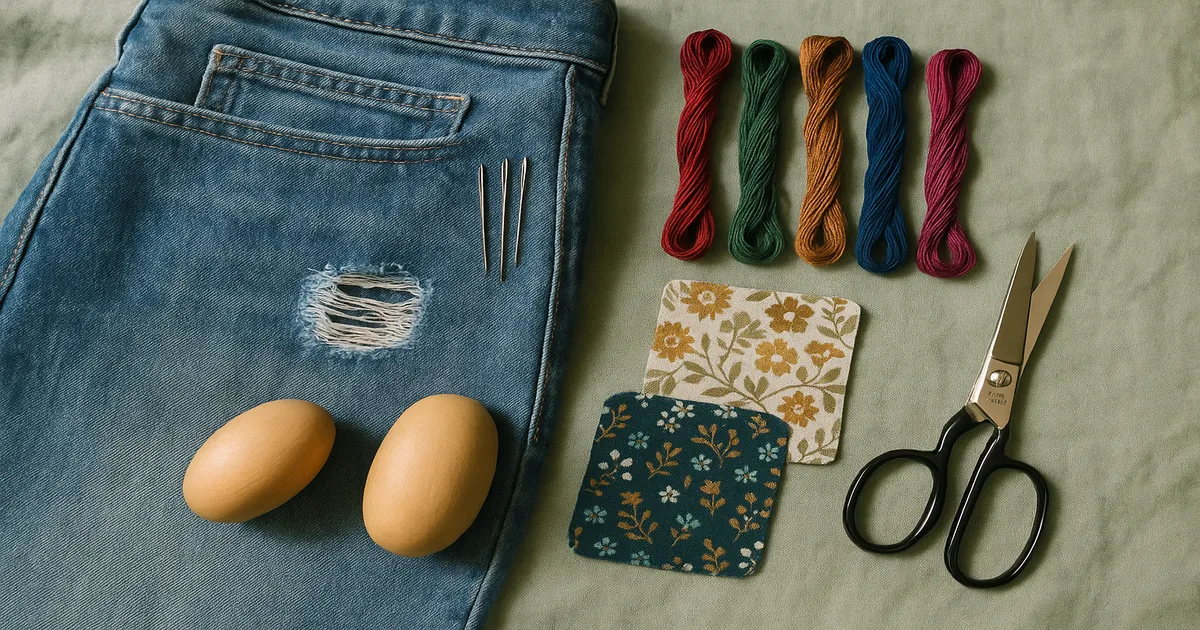
Quick Answer: To sew a hole, match your method to the hole size and fabric type. Small holes under ½ inch (13mm) in woven fabric? Use a hand ladder stitch. Knits, wool, and socks call for darning. Anything over 1½ inches (38mm) needs a patch — iron-on for speed, sewn for longevity.
Most tutorials jump straight to the stitching and skip the step that actually determines whether your repair holds: figuring out what you’re working with. How to sew a hole correctly depends as much on whether your fabric is woven or knit as it does on the size of the damage. Get that wrong and you’ll make the hole worse — or end up with a repair that blows out after two washes.
Quick Decision Guide
| Hole Size | Woven Fabric | Knit Fabric |
|---|---|---|
| Under ½ inch (13mm) | Ladder stitch by hand | Darn |
| ½–1½ inches (13–38mm) | Darn or small patch | Darn |
| Over 1½ inches (38mm) | Patch (iron-on or sewn) | Knit-compatible patch |
Assess the Hole Before You Pick a Method
This is the step most repair tutorials skip, and it’s the reason a lot of repairs fail within a week.
Woven vs. Knit: Why It Changes Everything
Woven fabrics — denim, cotton, linen, canvas — have threads running at right angles. When they tear, the edges stay relatively stable. Knit fabrics — jersey, sweater knit, fleece — are made of interlocking loops. Pull one thread and the damage can run. That’s why a hand stitch that works beautifully on a cotton shirt will pucker and distort a jersey T-shirt.
For knits, you need darning or a knit-compatible patch backed with fusible knit interfacing. Never woven interfacing on a knit — it locks out the stretch and causes bubbling after the first wash.
Check the Fabric Around the Hole
Measure the hole at its widest point, then press the area flat and look at the fabric within a 1-inch (25mm) radius. If it looks thin, worn, or has stress tears radiating outward, that whole zone needs reinforcement. Patching just the hole and leaving the thinning fabric around it is the single biggest reason repairs don’t last.
Trim Loose Threads Carefully
Trim any fraying threads to about ¼ inch (6mm) from the hole edge — not flush. Those short tails give your repair stitches something to anchor into. Cut right to the edge and you lose that grip.
Method 1: Hand Stitching a Small Hole
This is your go-to for small tears and seam splits under ½ inch (13mm) in woven fabrics.
What you need:
- Hand sewing needle (size 7–9 sharps for medium-weight cotton or linen)
- Matching thread — 50wt cotton for natural fibers
- Sharp embroidery scissors
- Straight pins or fabric clips
Cut about 18 inches (46cm) of thread — longer and it tangles constantly. Use a single strand for fine fabrics, double for denim or heavier cotton. Secure the end with a quilter’s knot: loop the thread around the needle two or three times, then pull the needle through.
The Ladder Stitch, Step by Step
The ladder stitch (also called a slip stitch or invisible stitch) pulls the edges together without a visible seam on the outside. It’s the right technique for how to sew a hole that you don’t want anyone to notice.
- Start ¼ inch (6mm) outside the hole on one side, needle coming up from the wrong side so the knot hides inside.
- Take a small horizontal stitch — about ⅛ inch (3mm) — along one folded edge.
- Cross directly to the opposite edge and take another ⅛-inch (3mm) stitch.
- Alternate sides. Every four or five stitches, pull the thread gently to draw the edges together. Gently. Don’t yank.
- Continue ¼ inch (6mm) past the hole on the other side to anchor into stable fabric.
Aim for 8–10 stitches per inch on medium-weight fabric. On fine fabric like silk or lawn, go tighter: 12–14 stitches per inch.
Finishing: Take two or three tiny backstitches — about 1/16 inch (1.5mm) each — to lock the thread. Pass the needle through the fabric a short distance and clip the tail close so it disappears into the weave. Press from the wrong side with a damp pressing cloth.
Method 2: Machine Stitching a Seam Split or Straight Tear
Machine repair is the right call for seam splits, straight tears, and heavier fabrics like denim or canvas.
Stitch length by fabric weight:
- Fine fabric (silk, lawn): 1.5mm
- Medium-weight (cotton, linen, light denim): 2.0–2.5mm
- Heavy fabric (denim, canvas): 3.0–3.5mm
Standard tension (4–5 on most machines) works for most repairs. On stretch fabric, use a triple straight stitch or a narrow zigzag (width 1.0–1.5mm, length 2.0mm) — a regular straight stitch will pop the moment the fabric moves.
Steps:
- Press the area flat to remove puckering.
- Fold each raw edge under by ¼ inch (6mm) and press. Pin or clip in place.
- Sew along the folded edge, starting ½ inch (13mm) before the hole and ending ½ inch (13mm) past it.
- Backstitch three or four stitches at both ends.
- Add a second row of stitching ⅛ inch (3mm) from the first on high-stress areas like inner thighs or underarm seams.
For an actual gap rather than a seam split, free-motion darning fills it with a grid of stitches. Drop the feed dogs, attach a darning foot, and move the fabric in a grid — horizontal rows first, then vertical. It takes a few minutes to get comfortable, but it’s fast and durable once you’ve got the feel for it.
Method 3: Darning a Hole in Knits, Wool, and Socks
Darning is different from every other repair method because it actually rebuilds the fabric structure rather than just closing the gap. A well-done darn on a wool sweater is genuinely stronger than the original fabric — and honestly, it’s one of the most satisfying repairs you can do.
Setting Up
Mount the fabric over a darning mushroom or egg, drum-tight but not distorted. The smooth rounded surface keeps the weave from pulling out of shape as you work. A smooth lightbulb works in a pinch.
Use a water-soluble marker to draw a rectangle around the hole, extending ¼ inch (6mm) beyond the damage on all sides.
Thread a blunt darning needle (size 14–18 for wool, sharp size 7–9 for cotton) with thread that matches the fabric weight. For a wool sweater, 2-ply or 4-ply wool yarn is right. For cotton socks, use a cotton darning thread.
Laying the Warp and Weaving the Weft
Run parallel threads vertically across the hole, spaced about 1/16 inch (1.5mm) apart, with tiny anchor stitches into solid fabric at each end. Lay them flat with zero tension.
Turn the work 90 degrees. Weave horizontally across the vertical threads in a plain over-one-under-one weave, alternating the sequence on each row. Space the weft threads at 1/16 inch (1.5mm) intervals to match the warp density. Anchor into solid fabric at the start and end of every row.
Don’t knot the thread ends — weave the tails back into the existing stitches for about ½ inch (13mm). Knots create lumps and weak points.
Finishing: Remove from the mushroom and steam-press gently. Don’t lean on it — pressing too hard compresses the repair and makes it stiff. A light hover with steam is all it needs.
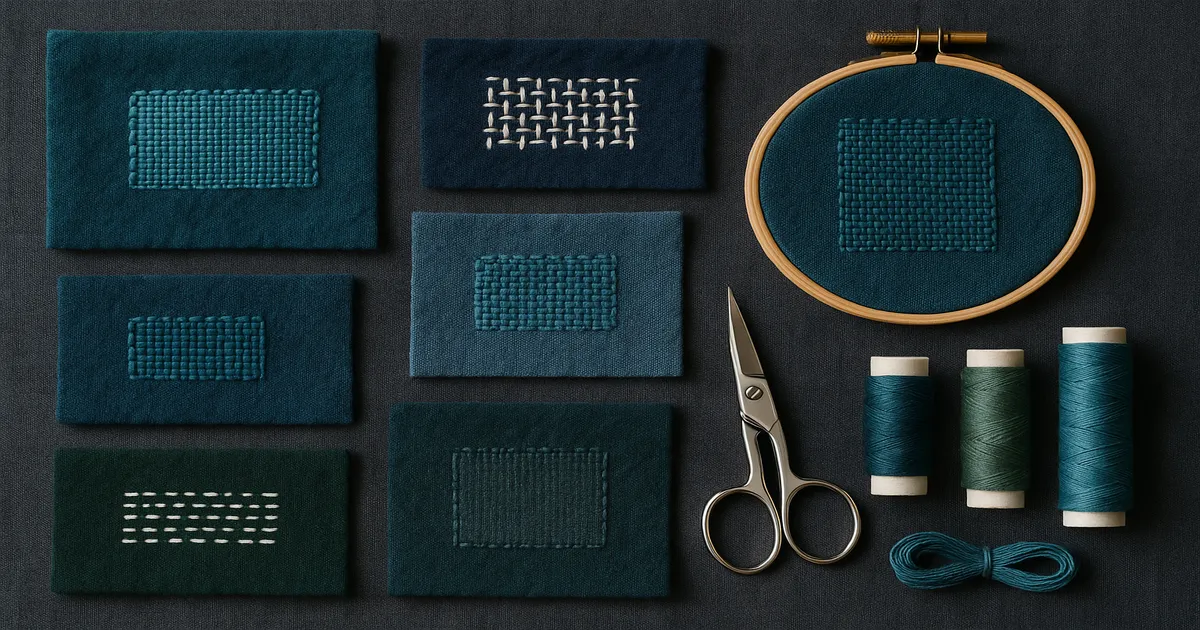
If you’re using contrasting thread, lean into it. The Japanese Sashiko and Boro traditions show just how beautiful an intentional, visible repair can be.
Method 4: Patching a Large Hole
Once a hole is over 1½ inches (38mm), you need a patch. There’s no stitching technique that reliably closes a gap that size without pulling apart under normal wear.
Iron-On Patch
- Cut the patch 1 inch (25mm) larger than the hole on all sides — a 2-inch hole needs a 4-inch patch.
- Round the corners. Square corners peel; rounded corners don’t.
- Position on the wrong side, adhesive side down, centered over the hole.
- Press with a hot iron for 30–45 seconds. Press firmly — don’t slide. Lift and reposition.
- Let it cool at least two minutes before touching it.
- Topstitch ⅛ inch (3mm) from the patch edge. Optional, but I’d always do it on anything that gets washed regularly.
Sewn Patch
For jeans, work pants, or kids’ clothing, a sewn patch outlasts iron-on every time.
- Cut patch fabric 1 inch (25mm) larger than the hole on all sides. For jeans, use matching 10–12 oz denim. Selvedge scraps are ideal — the edges are already stable.
- Fold and press the patch edges under by ½ inch (13mm) on all sides.
- Position over the hole, centered. Pin or baste in place.
- Edgestitch around the perimeter ⅛ inch (3mm) from the folded edge, then add a second row ¼ inch (6mm) from the first.
- From the inside, trim the original fabric behind the patch to within ¼ inch (6mm) of the hole edge to reduce bulk.
For knit fabrics, back your patch with fusible knit interfacing — not woven interfacing, which kills the stretch and causes bubbling after washing.
Tools and Materials
Needle Guide
| Fabric | Needle Type | Size |
|---|---|---|
| Fine woven (silk, lawn) | Sharps | 9–12 |
| Medium woven (cotton, linen) | Sharps | 7–9 |
| Heavy woven (denim, canvas) | Jeans/Denim | 16–18 machine; 3–5 hand |
| Knit fabrics | Ballpoint/Jersey | 9–11 machine |
| Wool and sweater knits | Blunt darning needle | 14–18 |
| Leather or vinyl | Leather/Glover’s | 16–18 machine |
Thread: Match the Fiber, Not Just the Color
Polyester thread is stronger than most natural fibers. Use it on linen or wool and it’ll gradually cut through the surrounding fabric. Use cotton thread on cotton and linen, silk on silk and fine wool suiting, wool or wool-nylon darning thread on sweaters. Your repair thread should always be the same weight or lighter than the original — never heavier.
Essential Tools
- Darning mushroom or egg — non-negotiable for darning
- Embroidery hoop (4–6 inch / 102–152mm) — keeps thin fabrics flat during hand repairs
- Water-soluble fabric marker — always test on a scrap first
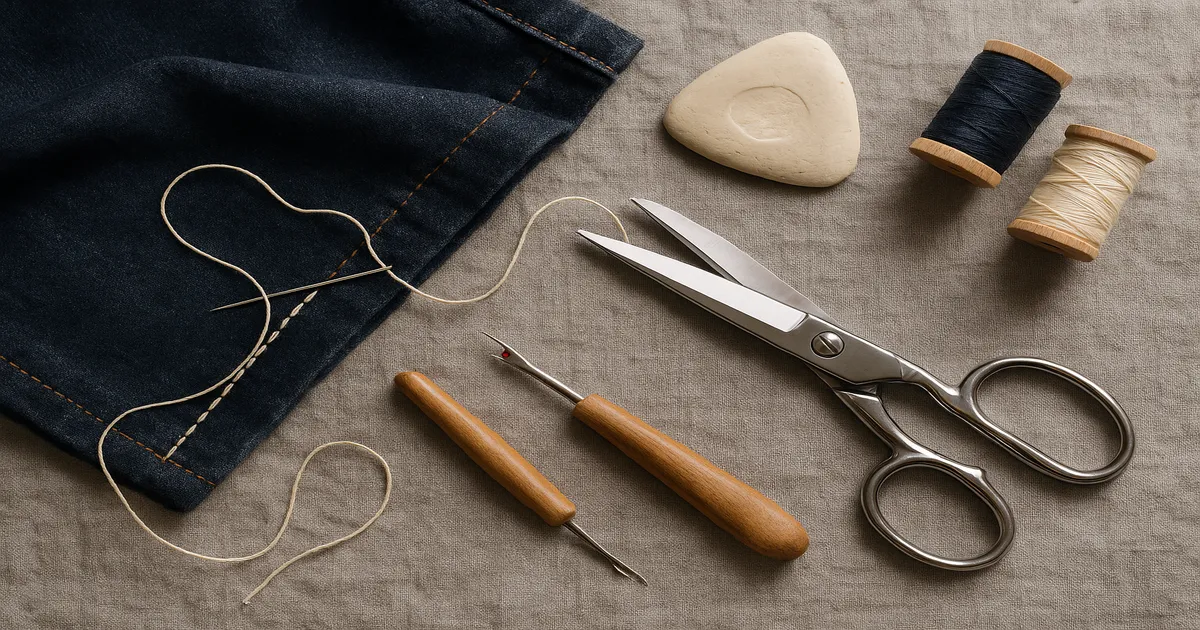
- Sharp embroidery scissors — small and pointed, for trimming close without nicking the fabric
- Seam ripper — for opening seams to access a repair from the inside
- Iron and pressing cloth — thin cotton muslin protects delicate fabrics from shine
- Thimble — worth it when you’re pushing through multiple layers of denim
- Beeswax thread conditioner — run thread through it before hand sewing to reduce tangling and add strength, especially useful for darning
Common Mistakes to Avoid
Pulling stitches too tight on knits. Tight stitches pucker the fabric and can extend the tear. Keep tension relaxed and let the fabric lie naturally.
Using polyester thread on natural fibers. It’s stronger than wool or linen and will cut through the surrounding fabric over time. Match the fiber.
Not extending the repair into stable fabric. Starting and ending right at the hole edge means you’re anchoring into already-stressed material. Always go ¼ inch (6mm) past the hole on both sides.
Using woven interfacing on knit fabric. It locks out the stretch, causes bubbling after washing, and makes the repair more obvious than the original hole.
Skipping the fabric assessment. Miss the thinning around the hole and the fabric will blow out again — usually in a slightly different spot — within a few washes.
Pressing a darn too hard. Steam-press gently. Leaning on a darn with a hot iron flattens the woven structure and leaves a stiff, uncomfortable patch.
Frequently Asked Questions
What’s the easiest stitch to close a small hole by hand?
The ladder stitch (also called a slip stitch) is the easiest and most effective for small holes in woven fabric. You alternate small stitches on either side of the hole, then pull the thread gently to draw the edges together. Done with matching thread, it’s nearly invisible on the right side.
Can you sew a hole in knit fabric without it puckering?
Yes — but you have to use the right technique. Darning works with the fabric’s structure rather than pulling against it, which is why it’s the best option for most knit holes. If you’re patching instead, use fusible knit interfacing as backing. Woven interfacing will cause exactly the puckering you’re trying to avoid.
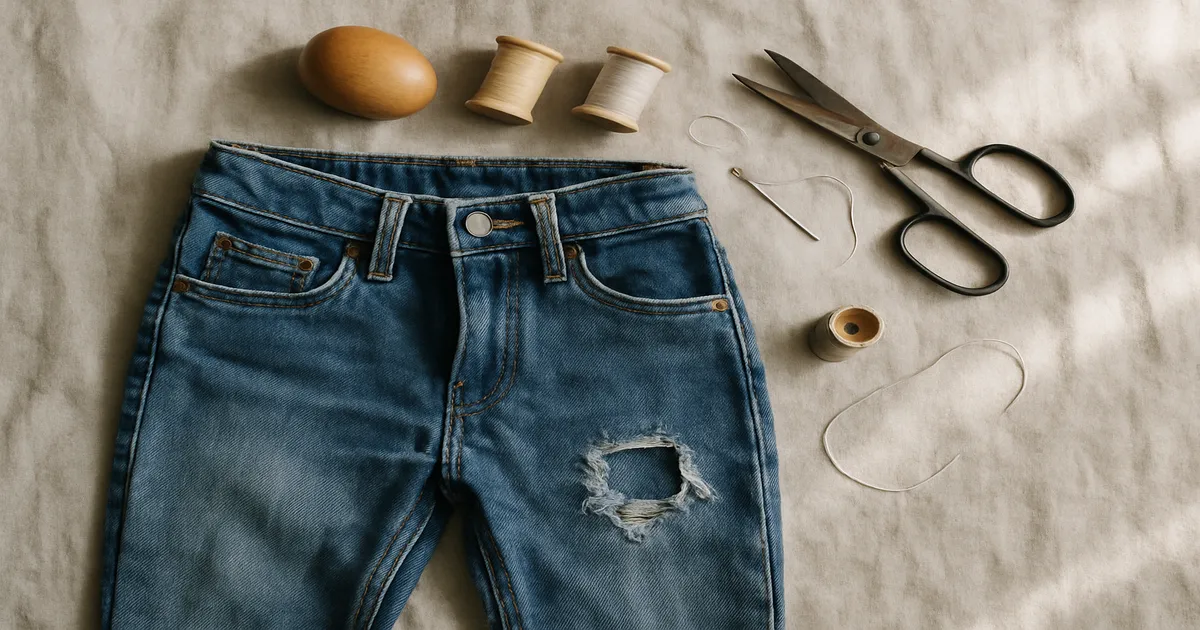
How do you repair a hole in jeans so it doesn’t show?
For small holes, a ladder stitch in matching thread from the inside is your best bet. For larger holes, patch from the inside using matching denim — the patch supports the fabric without being visible from the right side. On inner thigh holes, machine darning with matching thread often gives the cleanest result because it blends into the denim’s texture.
Is it better to patch from the inside or outside of a garment?
For an invisible repair, patch from the inside. The patch supports the fabric and the stitching reads only as a subtle texture on the right side. Patching from the outside is a deliberate style choice — visible mending with contrasting fabric or embroidery thread — and it’s structurally just as strong if the stitching is done well.
What thread should I use to darn a wool sweater?
Use a wool or wool-nylon blend darning thread matched to your sweater’s weight. A 2-ply or 4-ply wool yarn works for most sweaters. The nylon content in dedicated darning threads (typically around 25%) adds durability without making the repair scratchy. Avoid cotton or polyester — they don’t have the right elasticity for wool and will feel stiff against the skin.